

Who's winning the comedy business?
Samay Raina is taking the biggest bag home. Till when?

If you’re a Claude Code power user, here’s a question for you.
When was the last time you exchanged ideas with another builder? Swapped real workflows or just felt inspired? Been a while?
We’re hosting a Claude code showcase this weekend across 6 citities. Reasons to join:
Gurugram, Nishkarsh is attending. He’s built a financial analyst on Claude code that’s earned him ₹3L in 2 months (tickets). Bangalore, Aaradhya’s going to be here. She’s built a growth analyst on Claude Code that saves her team 4 hours every single day (tickets). Pune, Piyush’s coming too. He automated long-tail B2B lead gen — social listening, lead qualification, and WhatsApp outreach — all in a human-in-the-loop (tickets).
Mumbai, Shubham’s joining you. He’s built a finance workflow for short and medium-term trading, with every lesson from managing crores in AUM baked in (tickets). Jaipur, Surbhi’s going to be here. She went after the two things every founder guards hardest: money and time. Her workflows protect deep work, automate lead gen, and only pull her in to close (tickets). Hyderabad, Ramachandra Vikas is coming too. He’s built SEO and AEO for devs — a full terminal UI to help get your product discovered on ChatGPT and Google (tickets).
Today’s edition.
There is a running joke in the stand-up circles. Everyone gets paid to make the audience laugh, but the comedian takes home the smallest cut.
Indian comedians have been trying to solve this problem over the last 25 years. They’ve got the stand-up to show pipeline figured out. More fame = more specials = more tours = more money. But is it really sustainable?
We spent the last few days investigating it. Here’s what we found.
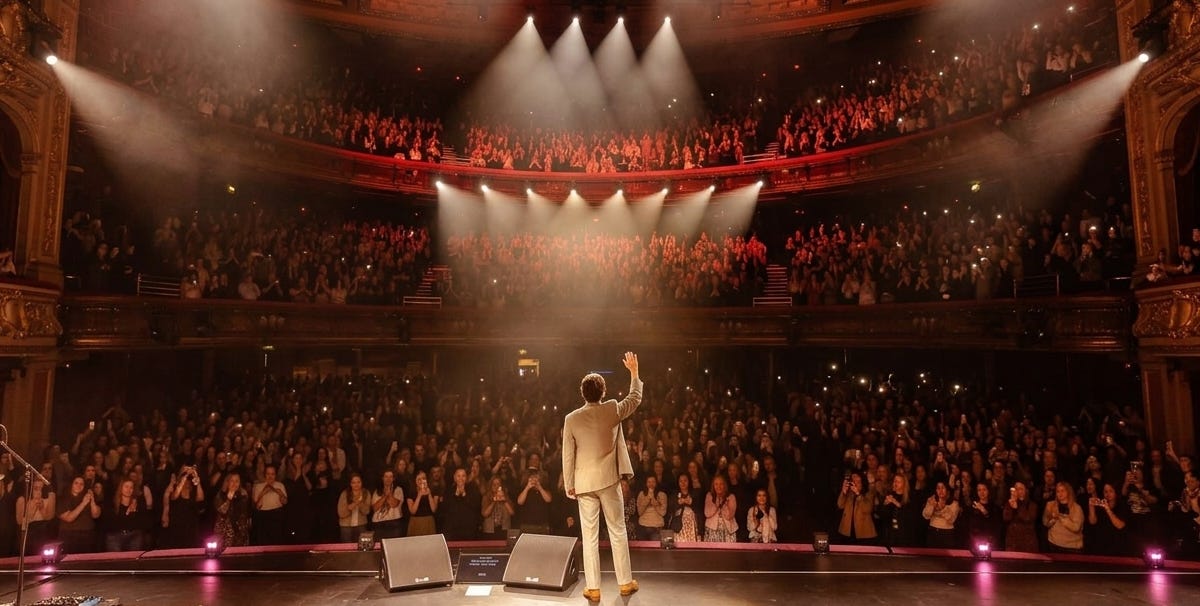
Comedy’s business problem is the product.
A stand-up comedian’s core output, a live performance, needs physical presence. You cannot be everything, everywhere, all at once. Nor can you delegate delivery. In short, it’s a non-scalable business.
The industry has tried to decouple the comedian’s presence from revenue for years. Result? Recording, broadcasting, streaming, podcasting, every medium takes the larger cut.
It’s simple economics.
The comedian needs distribution to sell more tickets for their tours (their highest-margin product). The platform — whether it is Amazon or YouTube provides them with that. And the comedian is willing to bear that cost. But why?
Television: the mass-distribution engine.
What is the real value proposition for television?
It’s not the 30 minutes of screen time. It’s the free distribution to tens of thousands of households across all age groups at once.
For a TV channel, the incentive to run a comedy special is different.
A 30-minute family comedy show does something no targeted ad campaign can: it puts a grandmother, her son, and his teenager in front of the same screen at the same time. For a brand, that is not a viewership number. That is the entire household purchasing unit, assembled and waiting. Plus, the higher the TRP, the more engaged the audience, and the more money the channel earns.
Now, let's look at how much each party took home from Comedy Nights with Kapil in 2013.
A 10-second ad slot on Comedy Nights with Kapil costs ₹1 to 1.25 lakh. TRAI, at that point, had an ad cap of 12 minutes per hour, which is 72 ten-second slots. At ₹1 lakh per slot, that is ₹72 lakh per episode from spot advertising alone. Add a title sponsorship to that, and suddenly the figure balloons.
How much did Kapil take home?
We don’t have the exact numbers for Comedy Nights with Kapil. But if he took Rs 35 lakh per episode for The Kapil Sharma Show in 2016, even a simple back calculation shows the figure was much lower in 2013.
Think about it. It was Kapil’s show, but the television network took away more money than he did.
OTT - the golden ticket.
For a comedian, moving to a platform like Amazon is an obvious choice.
You get an audience from day 1 — an international diaspora audience across 200 countries, with the cultural context and money, but no way to watch the live show. So, having an OTT special could open doors to international touring, and given the margins comedians get to keep here are greater, you do the math.
What does the platform have to win, though?
Pay once. Keep the content permanently. Every new subscriber who joins in 2019, 2023, or next year watches the same special at no incremental cost. The comedian’s work becomes a catalogue asset that quietly justifies subscriptions long after the cheque was cashed.
That’s exactly why Amazon Prime platformed Indian comedians through Specials in the first place.
Think about it.
You’re trying to crack the Indian market. You have a huge competitor, Netflix, that’s just announced Sacred Games, a show millions are excited to watch. Meaning you have a smaller audience to capture from your total market.
Nitesh Kripalani, Amazon’s country head, said, “We have seen that comedy is a top genre. Irrespective of whether it is a movie or a TV show, comedy just works. Also, a lot of these comedians are difficult to get one’s hands on because their tickets sell out pretty quick. And that was the opportunity that we recognised.”
The comedian got reach. Amazon got a library. And unlike a television contract, a perpetual licensing deal never comes up for renegotiation.
Unlocking exponential viewership.
If one comedian has 10,000 followers and another has 50,000. Who should you bring on a platform?
Correct answer: both. Now, the show becomes an event and has a larger collective audience. Better viewership = better ad revenue.
Look at Son of Abish.
Launched in February 2014, the late-night variety talk show ran for 9 seasons and accumulated over 153 million views on his channel. The format brought in comedians, musicians, and actors as guests each episode, giving Abish a recurring show and giving guests a platform they could not have built alone.
Now, the channel's revenue numbers aren’t public. But let’s make an estimate based on today's factors. Revenue came from YouTube’s ad share — 55% of whatever the episodes generated at Indian CPM rates. For YouTube, 153 million views at Indian CPMs could generate somewhere between ₹1.5 crore and ₹4.5 crore in total ad revenue — of which YouTube kept 45% without producing a single frame of content. The rest, perhaps, went to Abish.
Comicstaan followed a similar format. Getting famous names and new ones together on a single stage. Everyone got fame, the winner took home a prize, but the platform kept the revenue share.
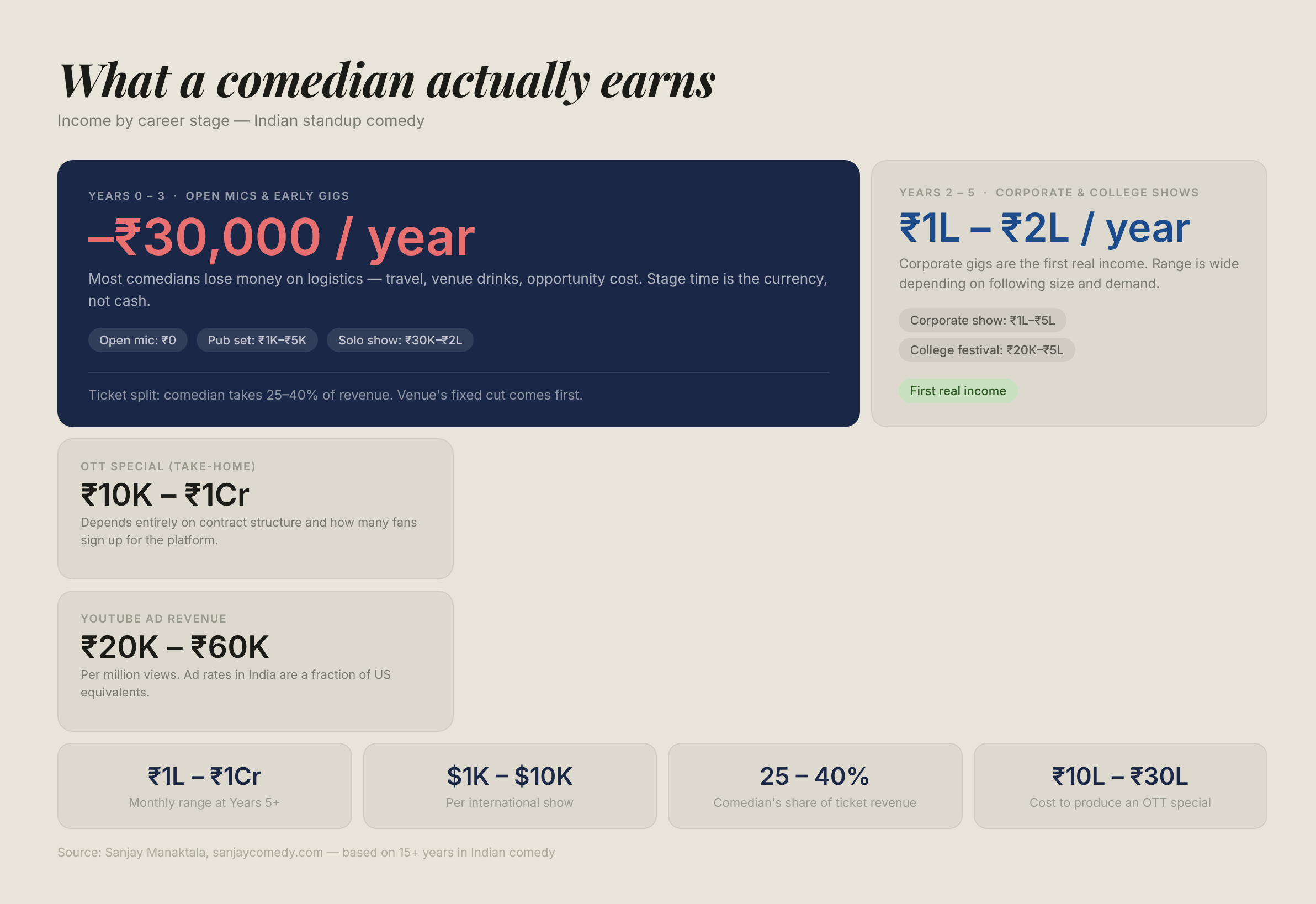
Every revenue stream available to a comedian so far, TV fees, OTT deals, YouTube ad revenue, brand sponsorships — was priced on the same underlying asset: how many people were watching.
Plus, the comic always needed to front a brand. That too, had a cap.
Diversifying the money flow.
AIB’s insight in 2015 was simple.
They were not a comedy group that happened to write. They were a writing company that happened to use comedy as the delivery mechanism. The skill was portable, and the audience was not the only place to sell it. Besides, YouTube revenues had reached a cap (India has some of the lowest ad revenue even now). AIB was already getting brand deals, but agencies were always the middlemen, pocketing ~15% of the total income.
So, in 2015, they launched Vigyapanti: a media unit that would work directly with startups and charge only for production.
Tanmay built on that idea after 2020, after AIB dissolved. He launched Moonshot Agency and went on to create ads for brands like Cred and Boldcare.
Zakir Khan took a different route.
Rather than building infrastructure, he extended his persona into adjacent territory. He launched Mehfil Biryani — a consumer brand built on the same emotional register as his comedy: nostalgic, desi, warm. He expanded into web series, poetry circuits, and Amazon Mini TV. Each move creates an income surface that does not require him to be on stage that week.
Most comedians, however, take a third route.
The default playbook: use the fame to open adjacent doors. Kanan Gill appeared in Noor and Ludo. Anubhav Singh Bassi showed up in Tu Jhoothi Main Makkaar. It’s widening the income surface instead of building a business that really compounds.
What Samay actually built.
Against this backdrop, India’s Got Latent in 2024 was something genuinely new. Not because it solved the problem. Because it found a position within the problem that no Indian comedian had previously found.
Three things, specifically.
1. A recurring revenue that is independent of brand deals.
₹59 per month from YouTube memberships arrives whether or not Samay films an episode that week. No Indian comedian had built this before. AIB had no equivalent. Zakir Khan has no equivalent. It is the first time an Indian comedian built something that pays them without performing.
2. A brand integration model where the advertising is the entertainment.
When Spinny sponsored India’s Got Latent, Samay introduced them as “Swiggy,” refused to wear their T-shirt, and read their brand brief in a mockingly irreverent tone. Customers started sharing photos of their “brand new second-hand cars” on social media. The brand did not interrupt the show. It became the show.
This allowed Samay to charge Rs 35 lakh per episode. Not as a sponsorship fee. As a media buy, the way a television channel sells an advertising slot. The pricing structure is categorically different from anything an Indian comedian had charged before.
3. An owned distribution layer via the app
That reduces platform dependency at the margin.
The result: during India’s Got Latent’s peak, Samay was keeping a higher percentage of a larger number than any Indian comedian in history.
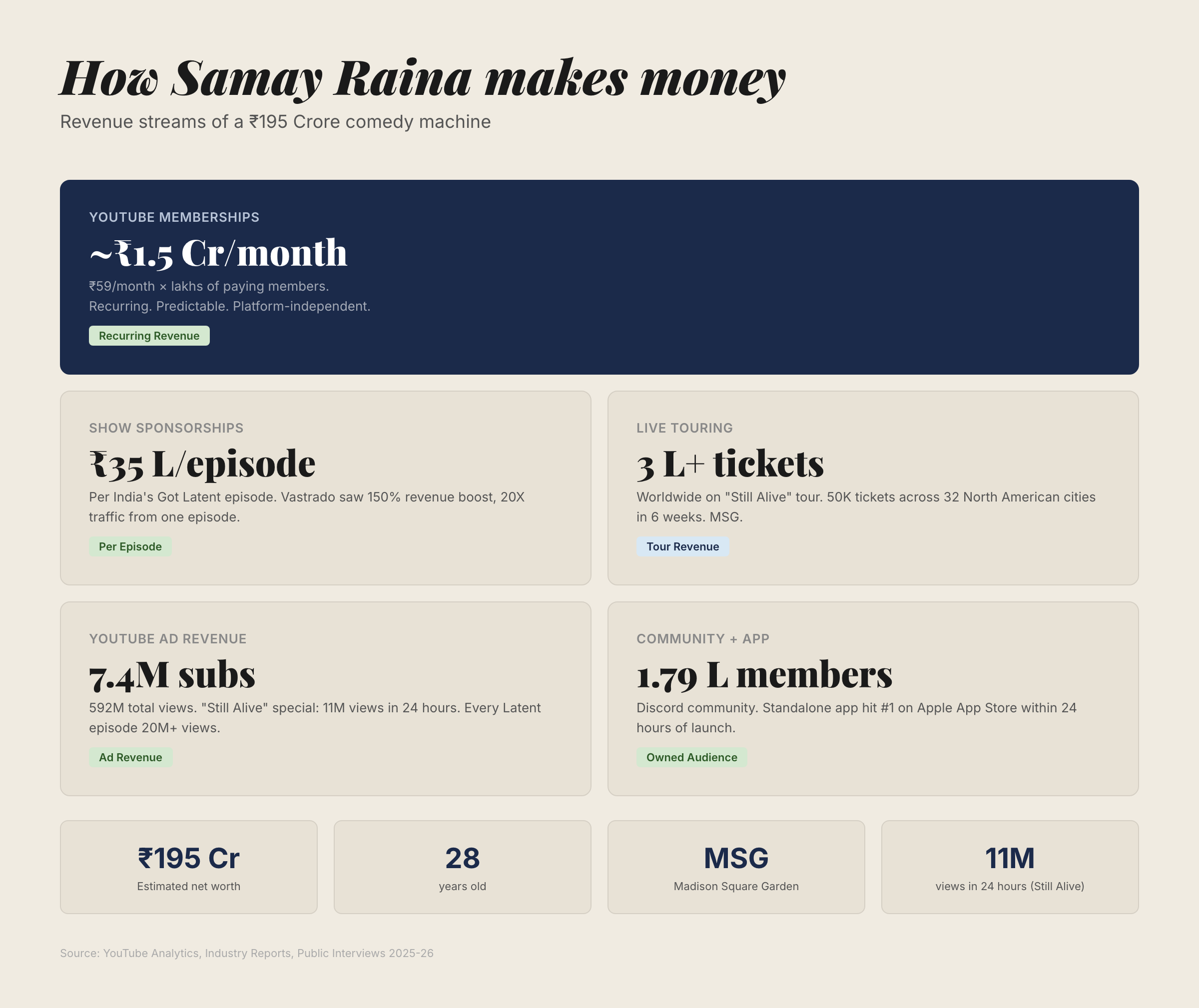
Over eighteen months, more than 32 brands partnered with India’s Got Latent. Each paid ₹30–40 lakh per integration. Those brands were not buying an ad slot. They were buying into a show that 20 million people watched voluntarily. Samay was both the creative and the distributor simultaneously.
Moonshot writes great ads. But those ads still need a platform to place them on.
So which model actually wins?
Here’s what we think. Samay generates more money and more cultural impact in a good year. But it requires the content to keep churning — new episodes, new integrations, new viral moments, every single week. Another controversy, and history repeats itself. Brands cancel deals, and videos taken down overnight.
Tanmay’s model generates less noise. But it keeps running when things go wrong — because the company is bigger than the person.
That’s all for today. If you liked this edition, support our work by sharing it with your network.
Hiee. I feel like I'm completely out of touch from the indian community here on Substack. Here's something i wrote. It's a fresh take on the indian stand up scene. If you love Shakespeare or Samay. Give it a read maybe? No pressure. ❤️
https://lostbard.substack.com/p/jesters-privilege?utm_source=share&utm_medium=android&r=19ba1x