

ITC’s ₹20,000 Cr. profit engine cracks.
How the new cigarette tax forced the company to restructure its business.


ITC just posted its Q1 FY27 numbers. Revenue up 27.6%. But costs went up 48%. And profit fell in the same quarter. The main reason for both: excise duty on cigarettes.
ITC has a plan to protect its business. But will it work?
Before we begin.
Been trying to get better at AI? Workflow guides are a good start. But they won't get you ahead.
The founders, PMs, marketers, designers and engineers using Claude, Lovable and even Cursor — everyone who’s actually shipping — are inside GrowthX, building every weekend.
Build-focused events, expert-led sessions, AI credits, feedback, and community. It’s all in here.
What is the new excise duty?
Before, GST was calculated on the factory price that ITC charges a distributor. Now it is calculated on the retail sticker price the consumer sees. That price is always higher — it includes the distributor’s cut, the shopkeeper’s margin, everything in the chain.
It’s basically the same cigarette, just a much larger tax base.
On top of that, there’s a brand new fixed charge per stick — ₹2,050 to ₹8,500 per 1,000 sticks depending on cigarette length. So, it doesn’t matter if the stick costs ₹10 or ₹25, the same charge gets applied. The cheaper end of the market takes a proportionally bigger hit.
Plus, the Compensation Cess, which existed since 2017 and could be offset against GST payments, was abolished. At the same time, the excise duty increased.
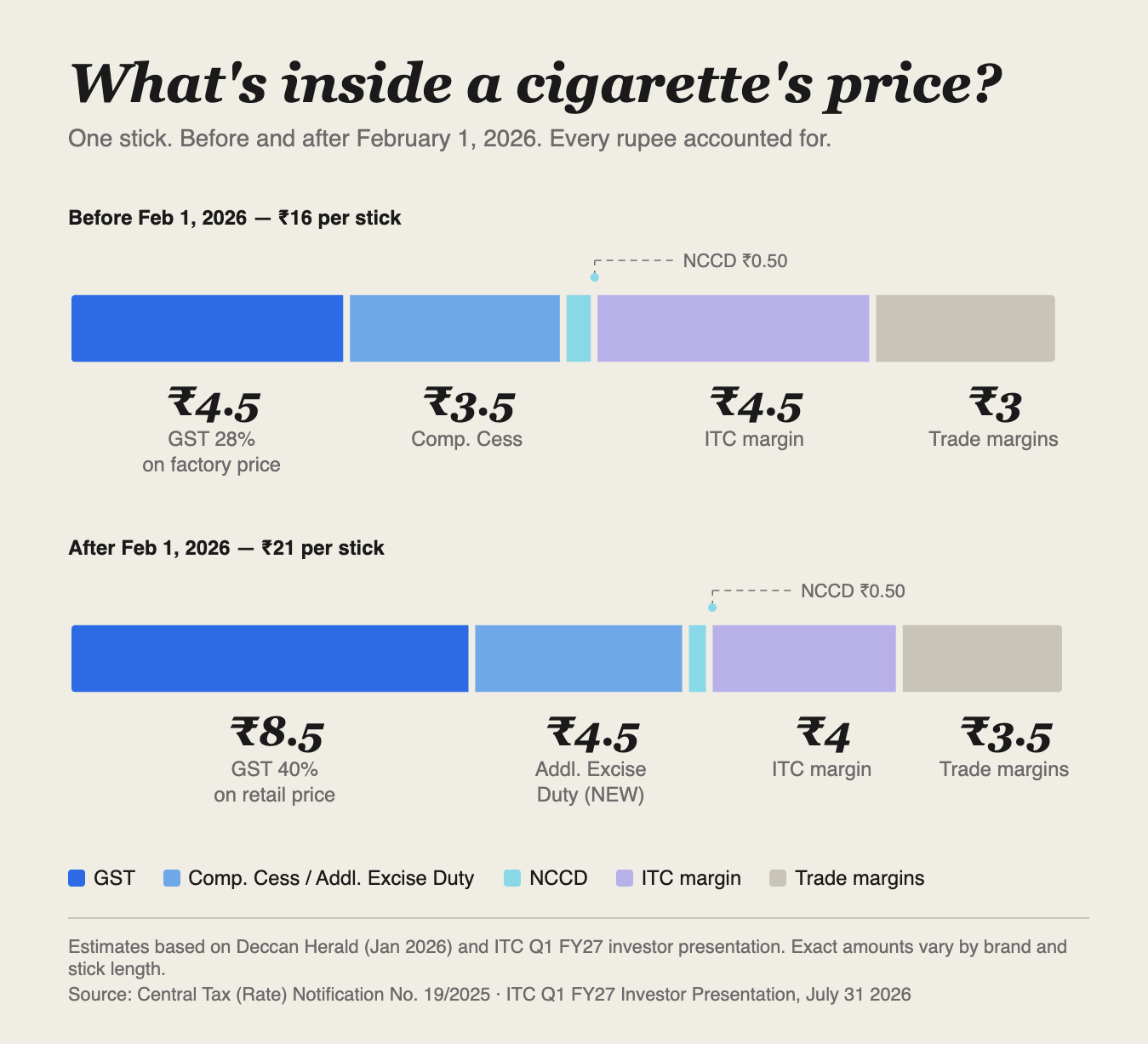
And that’s impacting ITC’s business.
Cigarettes fund all of ITC’s businesses.
See, ITC was never trying to escape cigarettes. For the first 65 years of its existence, it was not even trying to be anything else.
The packaging division came first, in 1925.
Honestly, it was a supply chain move. ITC needed cigarette packaging and decided to make it in-house. The paperboards business followed in 1979 for the same reason. Even Tribeni Tissues, acquired in 1990, was described in ITC’s own records as “a major supplier of tissue paper to the cigarette industry.” Every early expansion traced back to one question: what does the cigarette business need?
Hotels broke that pattern.
In 1975, ITC acquired a property in Chennai and opened its first hotel. The logic?
Deploy surplus funds from tobacco operations into regulated alternatives. India’s industrial licensing regime meant you could not simply invest cigarette profits back into more cigarettes.
Hotels were a permitted destination for capital. That’s why ITC invested in them.
Next came the FMCG expansion.
By 2001, the regulatory environment for tobacco was tightening globally. Given the advertising bans, health warnings, and rising taxes, ITC decided to double down on the FMCG segment.
That birthed the FMCG brands from ITC that we know today — Sunfeast, Buingo and Aashirvaad — all being built entirely on cigarette profits. Today, the FMCG segment generates ₹479 Cr. in profits combined. Whereas cigarettes, even today, generate ~₹3341 Cr. in the same quarter.
Truth is, FMCG is expensive in ways cigarettes simply are not.
Cigarettes cannot be advertised — COTPA 2003 bans all promotion. Every rupee of cigarette margin is earned without spending a rupee on customer acquisition.
Meanwhile, FMCG competes against HUL in personal care, Parle and Britannia in biscuits, Nestle in noodles. It needs advertising, trade spend, distribution investment, cold chain for dairy, separate supply chains per category. The funds for that come from cigarette profits. And now, those very profits are at stake.
The new tax structure has hit ITC hard.
To understand the situation ITC is in, let’s look at what its competitors had to do.
Let’s start with Godfrey Phillips (GPI).
It has Marlboro, the strongest cigarette brand in the world, premium positioning, and price-inelastic buyers. If any company in India could pass through a 50% tax hike without losing volumes, it should have been GPI.
The company raised prices aggressively. Domestic volumes fell only 2%. And profit still fell 44.3%. The price increases did not fully recover the tax burden. Even Marlboro could not bridge the gap between what the tax cost and what the market would bear.
VST fared worst.
Its brands Charminar and Charm both sit in the value segment. When prices went up, consumers walked. Volumes fell 14.4% quarter-on-quarter. VST’s own management named where they went: cheaper contraband and illicit cigarettes. Margins collapsed simultaneously.
ITC chose differently.
ITC’s cigarette segment reported ₹15,384 crore in revenue — up 81% on paper. Strip the excise duty ITC collected at the factory gate, passed to the government, and kept none of: revenue fell 25%. Profit fell 35%. What happened in the background? ITC absorbed part of the tax hike, raised prices slowly, and protected volumes now.
But why choose to absorb the hike?
ITC knew that margins lost this quarter recover when prices adjust, and consumers normalise to the new reality — ITC has been through this cycle in 2014, 2015, 2020.
But volume lost to illicit trade does not recover on the same timeline. A cigarette smoker is among the most habitual consumers in any category. Brand loyalty in cigarettes lasts years, sometimes decades. The moment a price-sensitive Gold Flake buyer switches to a cheaper illicit stick and finds it acceptable, the habit begins reforming around the new product. Every week that passes deepens the habit.
Besides, unlike FMCG, ITC cannot advertise to win them back. A biscuit company that loses market share runs a campaign. So, if a smoker defects to an illicit product, ITC’s only legal tool to recover them is price and availability — in a market where the illicit stick is already cheaper and equally available at the same kirana counter. That’s the math.
So, what is ITC doing?
Let’s look at their portfolio after the shock.
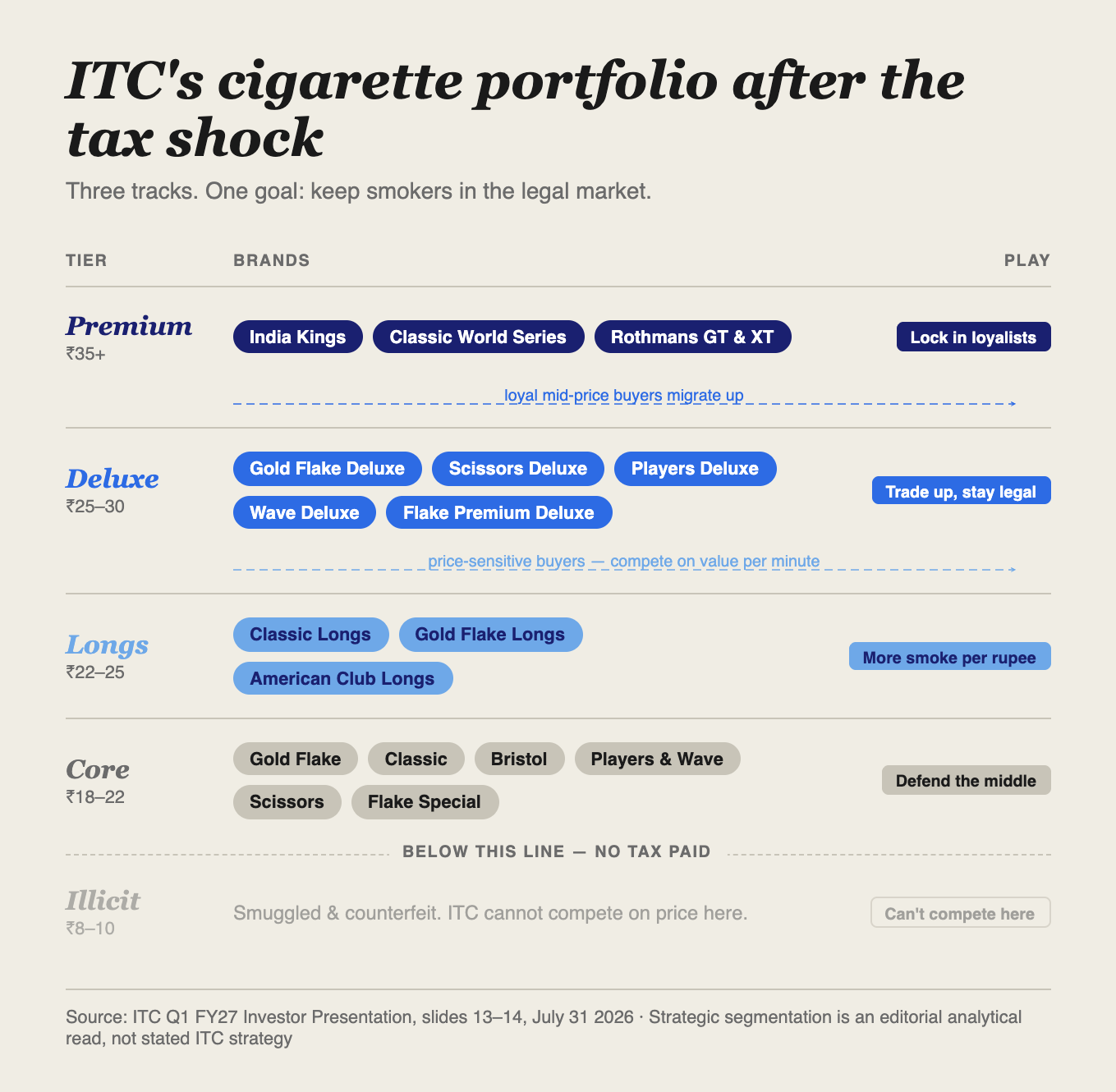
See, ITC is trying to cater to its buyers at all price points. But this time, the strategy is slightly different.
a. The premium buyer
This is someone who buys India Kings, Classic World Series at ₹42+ a stick. That’s someone who’s not doing any price maths. ITC’s job here is simple: keep the brand visible, keep dealer relationships tight. Logic: This buyer does not defect if they see their cigarette on the shelf.
b. The loyal mid-price buyer
Take Priya, seven years on Gold Flake Superstar. She’s not buying an illicit stick. But every price hike makes her quietly ask whether the cigarette is still worth what she is paying. ITC's answer is Gold Flake Deluxe on the same shelf — slightly better filter, same brand she trusts, just ₹4 more. Plus, ITC earns more per stick.
c. The price-sensitive buyer
Now, take Ramesh, two Gold Flake Kings a day; now paying ₹22 where he paid ₹18 is the hardest problem. The ₹10 illicit stick is on the same shelf. ITC cannot match that price. So it changes the question. Gold Flake Longs at ₹25 burn longer. More smoking time per rupee. Ramesh is now comparing value, not just price.
d. The value-end buyer
Bristol, Flake Special, ₹14 a stick before the hike — has the least room. Now at ₹18, the ₹10 illicit gap is proportionally the biggest of all four buyers. No Deluxe variant, no Longs format solves this. ITC’s only move is staggered pricing — raise slower than the tax demands, hope loyalty holds. This is the buyer VST already lost.
e. The young smoker
This is the fifth buyer ITC is not defending. It is recruiting. The Gold Flake Indie Paan Sleek, Players Magic Mix, American Club Clove Mint Fresh — flavoured, slim, experimental — are not for Ramesh or Priya. They are for a younger smoker who has not yet formed a brand habit. Someone who might otherwise never enter the legal market at all.
That’s the play.
What’s next for ITC?
Q1 is done. ITC survived it. But what will happen when the price hikes land? Three numbers will tell you that.
1. Cigarette volume in Q2.
If volumes stabilise despite full price hikes, the migration into Longs and Deluxe absorbed the shock. If volumes keep falling, illicit substitution is outrunning the restructuring.
2. Revenue per stick.
This is the cigarette segment revenue divided by units that tells you whether mid-price buyers moved up or moved out. Rising revenue per stick with stable volumes means Priya upgraded. Falling revenue per stick with falling volumes means Ramesh found the ₹10 alternative.
3. Illicit trade share (arrives with a 6-12 month lag)
There is also a variable nobody is currently modelling. If tax collections from legal cigarettes fall because illicit volumes rose, the government faces its own decision — enforce harder, or reconsider the structure. Either way, ITC will have to rethink its business.
This is perhaps why ITC is planning to take a new bet on the same leaf.
ITC IndiVision — a wholly-owned subsidiary in Mysuru — manufactures and exports pharmaceutical-grade purified nicotine to US and EU buyers who put it inside NRT patches, nicotine gums, and vaping products. The facility runs on the same e-Choupal supply chain that sources leaf for Gold Flake. As of Q1 FY27, the business has been PBIT positive for two consecutive quarters.
See, IndiVision isn’t a replacement for the cigarette business. The numbers are too small for that. But it is a signal that ITC understands something the quarterly results do not show: the tobacco leaf has more than one destination, and not all of them depend on how many Rameshs buy a Longs variant before the next price hike arrives.
Want to plug your brand into our newsletter?
Email us at collab@growthx.club