


Before we begin.
We conducted a massive buildathon last week. 150+ folks showed up. One finalist built a full product management task tracker in 6 hours. And he wasn’t even a coder.
100+ GrowthX members with 0 coding experience have built real AI tools with us. How? By being in the right room — one where ideas get challenged, builds happen fast, and feedback is sharp. We can get you in.
Today’s edition.
Let’s do a thought experiment.
There are two IPL teams. Team 1 is new. They’ve been in the game for 2 years and have stacked wins. Team 2 is much older. They’ve got a few star players and a few wins here and there.
Who do you think makes more money?
It’s team 2. And in this edition, we’ll explore why.
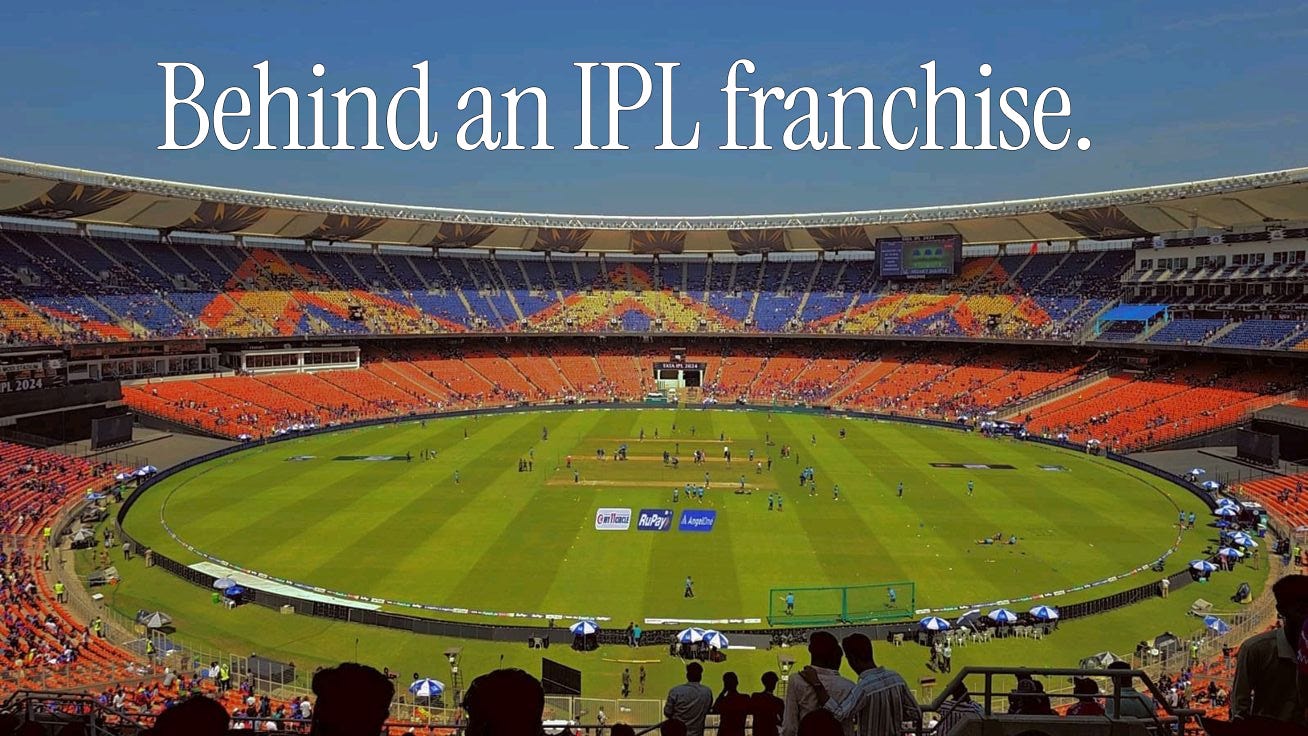
Both teams start on equal footing.
They receive ₹484 crore each from BCCI’s media rights deal — even before playing. That’s the kind of money that covers every player’s salary — and leaves ₹359 crore for other stuff, for every team. Long story short, both teams are profitable from day 1.
So, where do the meaningful profits come from?
Sponsorships are the lion’s share.
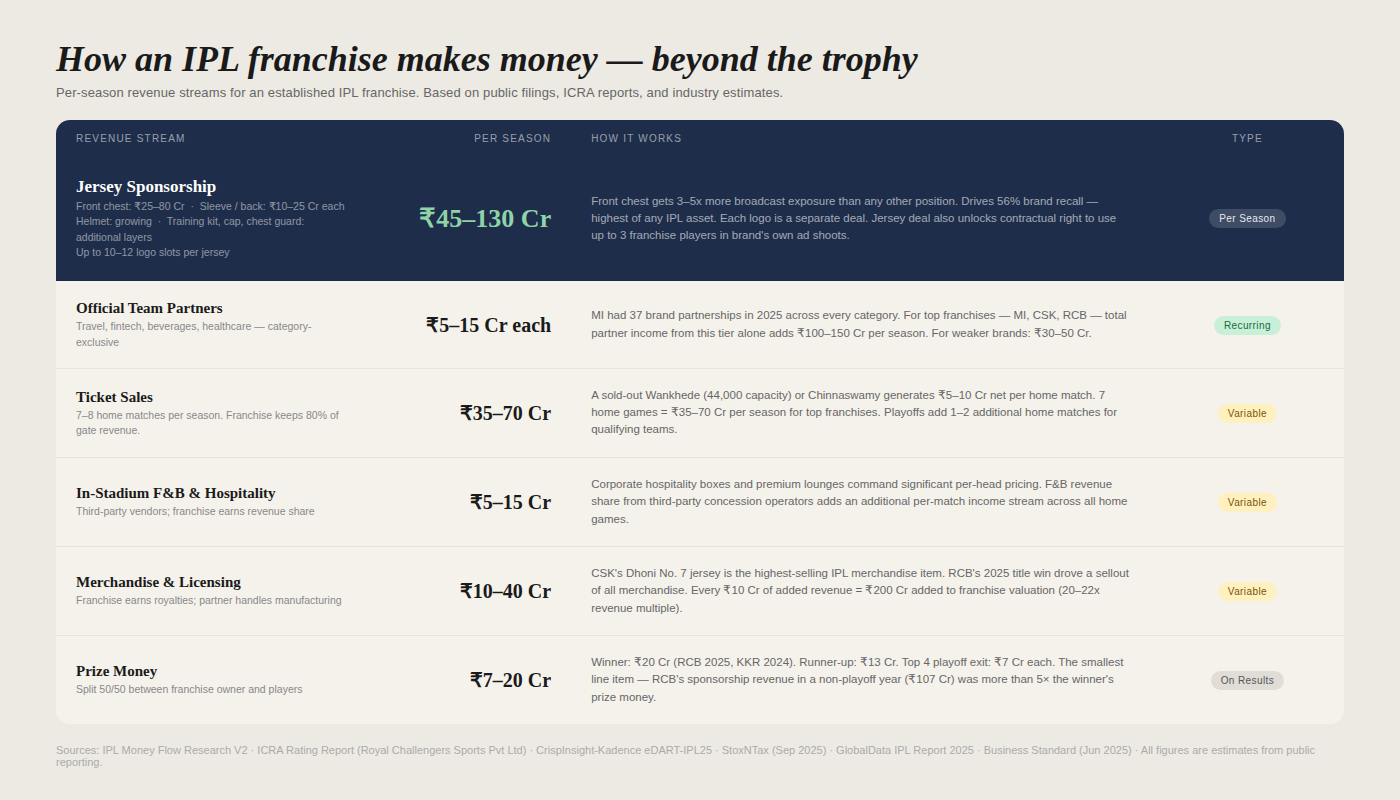
When RCB won the trophy, BCCI handed them ₹20 crore. Punjab Kings, the runner-up, got ₹13 crore. GT and MI, knocked out in the playoffs — ₹7 crore each.
Now look at what RCB made from sponsorships in the year they didn’t even qualify. ₹107 crore in 2023. Five times the winner’s prize money. Even in a losing year. Why?
Viewership is king.
Your goal as a brand is simple. Reach as many Indian households as possible, across every demographic, and be remembered.
The IPL is one of the few places where you can achieve this fast. You’ve got a captive audience for a ~5-hour slot. Viewership’s roughly 1.19 Bn.
You could get a TV ad slot, one 10-second spot at ~₹18–19 lakh. Spend ₹25 crore, buy about 130 of them, and it’s still <2 per match across a full season. There’s a high chance people might forget your ad even played, let alone remember your brand.
This is why many brands prefer option 2 — a jersey sponsorship.
Spend the same amount of money. But your logo is in every match broadcast, every highlight reel, every post-match interview, every franchise social media clip, and even on the merchandise fans buy. That’s 56% recall, higher than IPL ad placements!
Bonus: A jersey sponsorship means you can use up to 3 franchise players in a franchise jersey in your brand ads.
Let that sink in.
A ₹25 crore deal with RCB is also a deal to shoot Virat Kohli in an RCB jersey for your own campaigns. Jio has had that right on RCB’s sleeve since 2018. And it’s not because RCB plays well.
Viewership runs on players, not teams.
98% of IPL viewers have a favourite player, and only 37% have a favourite team. Case in point, in 2024, CSK vs RCB broke the all-time IPL viewership record at 50 crore cumulative views. Not because either team was top of the table. Because Dhoni and Kohli were on the same field.
That kind of viewership is what sponsors are really paying for. And franchises, in turn, maximise their chances of profitability by choosing the players to enable it.
Ticket sales are the second biggest profit contributors.
Two factors determine how much each franchise earns from ticket sales: its home ground capacity and its fan base.
Bigger stadium = more ticket sales. Bigger combined fan base = higher ticket price. Simple.
From this share, franchises must pay the hosting stadium rent per match and a 20% revenue share to the BCCI.
Here’s what those numbers (estimated) look like for the RCB in 2026.
Ticket prices range from ₹3,750 for a general stand to ₹65,800 for a VIP corporate box — the highest starting price of any IPL venue. A sold-out Chinnaswamy at a conservative blended average of ₹6,000–8,000 per seat generates roughly ₹21–28 crore gross per match.
BCCI takes ~₹4.2–5.6 crore while RCB keeps ~₹16.8–22.4 crore. When you subtract the ₹50 lakh rent to KSCA per match, home matches at Chinnaswamy bring in ₹98–131 crore for RCB every season.
But there’s another way to profit from match tickets. By selling exclusivity.
See, franchises also have the option to play home matches outside their designated city. Rajasthan Royals chose to play three home matches against CSK, MI, and RCB in Guwahati in IPL 2026. Why?
The commercial logic is straightforward. Bring Dhoni, Rohit, and Kohli to a market that has never seen them play live, and people will pay a premium for tickets.
In 2026, Barsapara Stadium's starting ticket price for these matches was ₹2,700, higher than Eden Gardens (₹400) and comparable to Wankhede. Packed stadiums were guaranteed. Corporate hospitality — untapped by years of no top-flight cricket — spiked. And Riyan Parag, RR's captain and a native of Assam, turned a neutral venue into a home ground overnight.
Luxury hospitality brings the biggest margins.
RCB knows this. That’s why, when they were looking for alternate venues after the Chinnaswamy stampede, they evaluated Indore and ruled it out because of the tiny number of corporate boxes.
Take a look at the estimated revenue contributions.
RCB's IPL 2026 hospitality pricing at Chinnaswamy runs from Platinum Lounge at ₹25,000–₹35,000 per seat to Diamond and P-Corporate boxes at ₹47,000–₹65,800. Each package includes catering, exclusive entry, and prime sightlines.
Even at a conservative 5% of 35,000 seats in hospitality (~1,750 seats), at an average of ₹40,000–50,000 per seat, gross hospitality revenue per match is approximately ₹7–8.75 crore. Six home matches at Chinnaswamy: ₹42–52 crore per season from hospitality alone.
Now compare that with the general ticket hospitality numbers.
At an average fan spend of ₹300–500 across 33,000 general admission fans, gross F&B revenue per match is roughly ₹1–1.75 crore. RCB’s share at an estimated 20–30% is approximately ₹25–44 lakh per match or about ₹3 crore per season.
That’s a 15X difference in revenue!
Merchandise comes last.
RCB merchandise — jerseys, caps, accessories — sells year-round, not just during the season. Through 17 years without a title, they consistently ranked in the top three in IPL merchandise sales. The reason is the same one that drives everything else: Kohli.
When RCB won the title in June 2025, every item sold out. Their brand value jumped from $117 million in 2024 to $269 million post-title — a 130% surge in one season. The title accelerated the merchandise business.
That is the full picture of how an IPL franchise makes money. Central pool. Sponsorships. Tickets. Hospitality. Merchandise. Stack it all up for RCB in FY2024, and you get ₹649 crore in revenue and ₹222 crore in profit.
Now, a question for you.
If winning does not drive sponsorships, and players drive viewership more than teams do, and the central pool pays everyone equally, what exactly are people paying ₹15,000 crore for?
The valuation paradox.
RCB was sold for ₹16,376 crore in March 2026 to Aditya Birla Group, Times of India, and Blackstone. Their profit in the year they won the title: ₹140 crore. Down from ₹222 crore the year before.
Nobody is buying these franchises for operating returns. Here’s why the franchises get purchased.
1. Scarcity.
BCCI has confirmed ten teams are the right number — for now. There is no mechanism to create a new franchise. When supply is permanently capped, and India’s consumer market keeps growing, the asset appreciates regardless of its annual earnings.
2. India’s trajectory.
750 million mobile internet users. The youngest major economy in the world. A media rights cycle that grew 300% in one auction. Every rupee of that growth flows directly into the central pool, then to franchise owners.
3. The trophy asset premium.
In 2022, 6% of the world’s billionaires owned sports teams. By 2025, that number was 20%. Sports replaced art and cars as the top speciality asset among the ultra-wealthy. IPL franchises — with guaranteed central revenues, no relegation, and a captive national audience are the most structurally protected sports asset on earth.
That’s all for today, folks. If you liked this edition, share it with a friend who would like it too. It’s free! :)