


Colgate moves product through 6.5 million outlets. It’s one of the most efficient FMCG machines in India. Palmolive, its sub-brand, has been sitting on that machine for 73 years.
And yet, in August 2026, CEO Prabha Narasimhan told analysts Colgate could not crack online sales for Palmolive. The solution: hand it to Bombay Shaving Company — a startup doing ₹635 Cr in revenue against Colgate India’s ₹5,984 Cr. But why?
Before we begin.

Getting good at AI isn’t a solo sport. But the people who move fast do it inside a community with live feedback from people who’ve already solved the problem you’re stuck on. GrowthX gives you that, plus AI credits from top companies and weekly AI sessions. Get it at ₹5000 off for one more day.
Colgate’s tools don’t work for Palmolive.
6.5 million outlets. That’s a distribution number most consumer brands would kill to have.
But take a closer look.
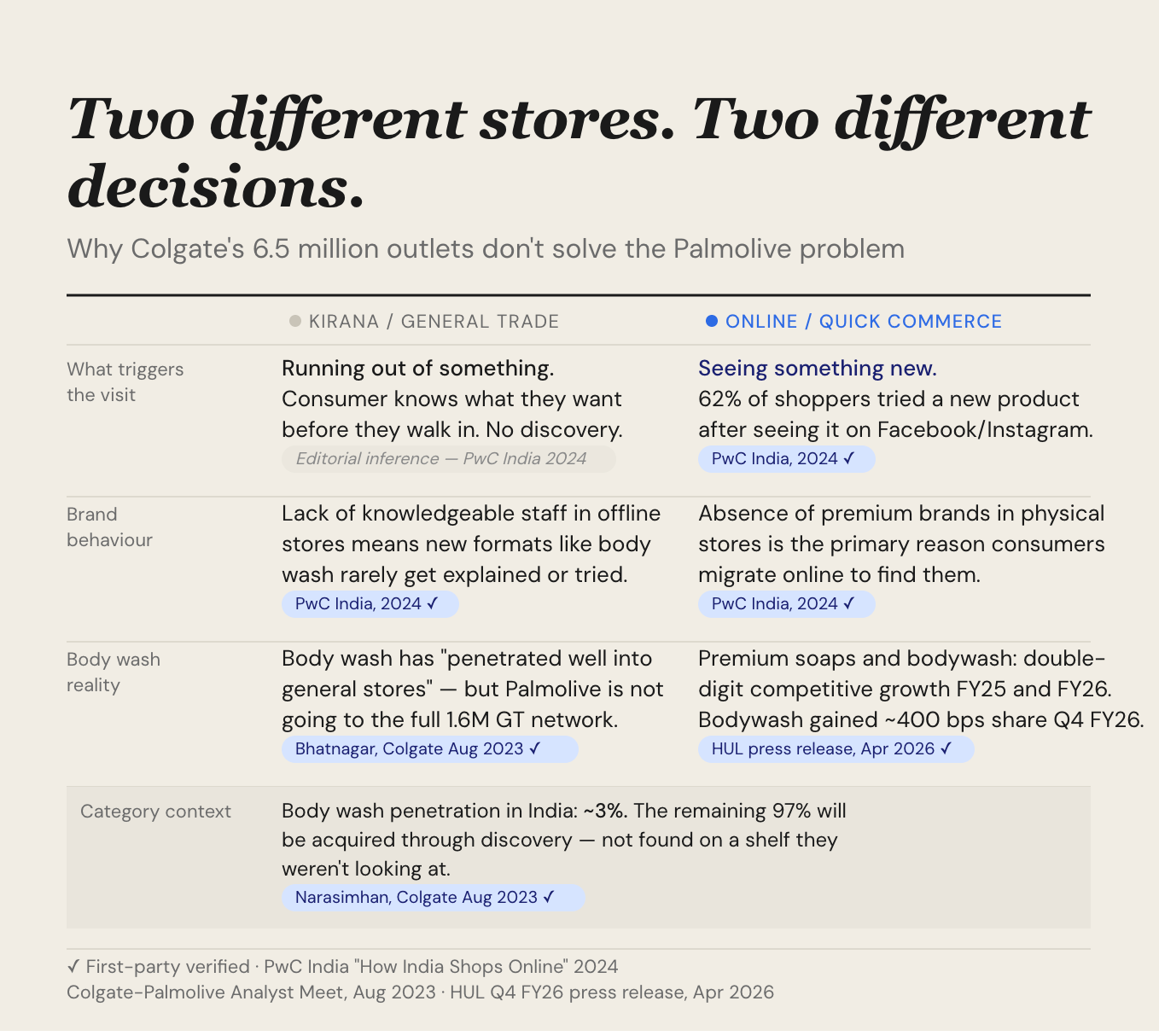
Colgate directly reaches only 1.7 million of those outlets. The remaining 4.8 million are indirect — kiranas, petty stores, small general trade where Colgate’s toothpaste moves on habit and brand recall built over decades.
These stores aren’t the place to look for a new body wash worth ₹300. Hence, Colgate’s milestones algorithm that cross-references toothbrush and toothpaste purchase data with neighbourhood affluence. To be honest, it’s a workaround.
Wait, why is Colgate betting on Palmolive if the infra isn’t there?
See, toothpaste penetration in India is near-universal. Meanwhile, body wash sits at 3% penetration and is growing at a 30-40% CAGR. The headroom is not comparable.
So Colgate pulled every lever available. Global formulations on tap from the parent portfolio. Palmolive Moments launched in FY26 with patented fragrance technologies. Premium placement in the right affluent stores.
But distribution can’t solve for habit.
See, the consumer switching from a ₹30 soap bar to a ₹300 body wash isn’t making a brand choice. She’s deciding to upgrade a daily ritual she has never paid much for. That decision doesn’t happen at a kirana shelf.
It happens online — through content, through a recommendation, through the right product appearing at the right moment. And then it has to happen again. And again.
So, why isn’t every other player in the category doing D2C?
They don’t need to.
HUL doesn’t need a D2C flywheel for Dove.
HUL doesn't need a D2C flywheel for Dove because it already owns the shelf Dove needs. Personal care is a ₹9,168 Cr business for HUL, a standalone segment with brands at every price point.
Lux, Lifebuoy, Pears, Dove. Decades of shelf relationships in every modern trade chain and premium GT store that matters. When Dove body wash needed distribution, it inherited it. HUL then layered a dedicated quick commerce organisation on top, built to fulfil demand from a consumer who already knows she wants Dove.
HUL's distributor reaches 8 million+ outlets carrying Lifebuoy, Lux, Surf Excel simultaneously — the retailer already has a personal care shelf conversation with that distributor before Dove bodywash is even mentioned. Colgate's distributor carries toothpaste. There is no personal care conversation to extend.
Same with ITC.
Fiama, Vivel, and Superia ride ITC's cigarette distribution network into every relevant store daily, covering everything from premium to mass personal wash from a van already making the stop.
How did Palmolive get here?
Palmolive is the one brand without an asset to lean on.
See, Colgate India draws roughly 95% of its revenue from oral care, and that number is the result of a deliberate choice. As HDFC Securities put it in 2021, the company “deliberately chose to focus on oral care in India” and would keep “pumping in more of its tremendous cash flows into the oral care segment” until it felt impregnable there. Every rupee of advertising, every management decision, every distribution push went to defending toothpaste. Palmolive got what was left.
By the same analyst’s account, Colgate “never significantly backed these products through above the line or below the line spend.” The products existed. The campaigns didn’t. Without campaigns the category didn’t move, and without movement there was never a business case to spend more. A cycle of underinvestment that ran for decades.
Hence the 67% awareness and almost no purchase consideration.
Why Colgate is betting on D2C for Palmolive.
Look at it yourself. A ₹300 body wash that people don’t purchase enough can win in one place.
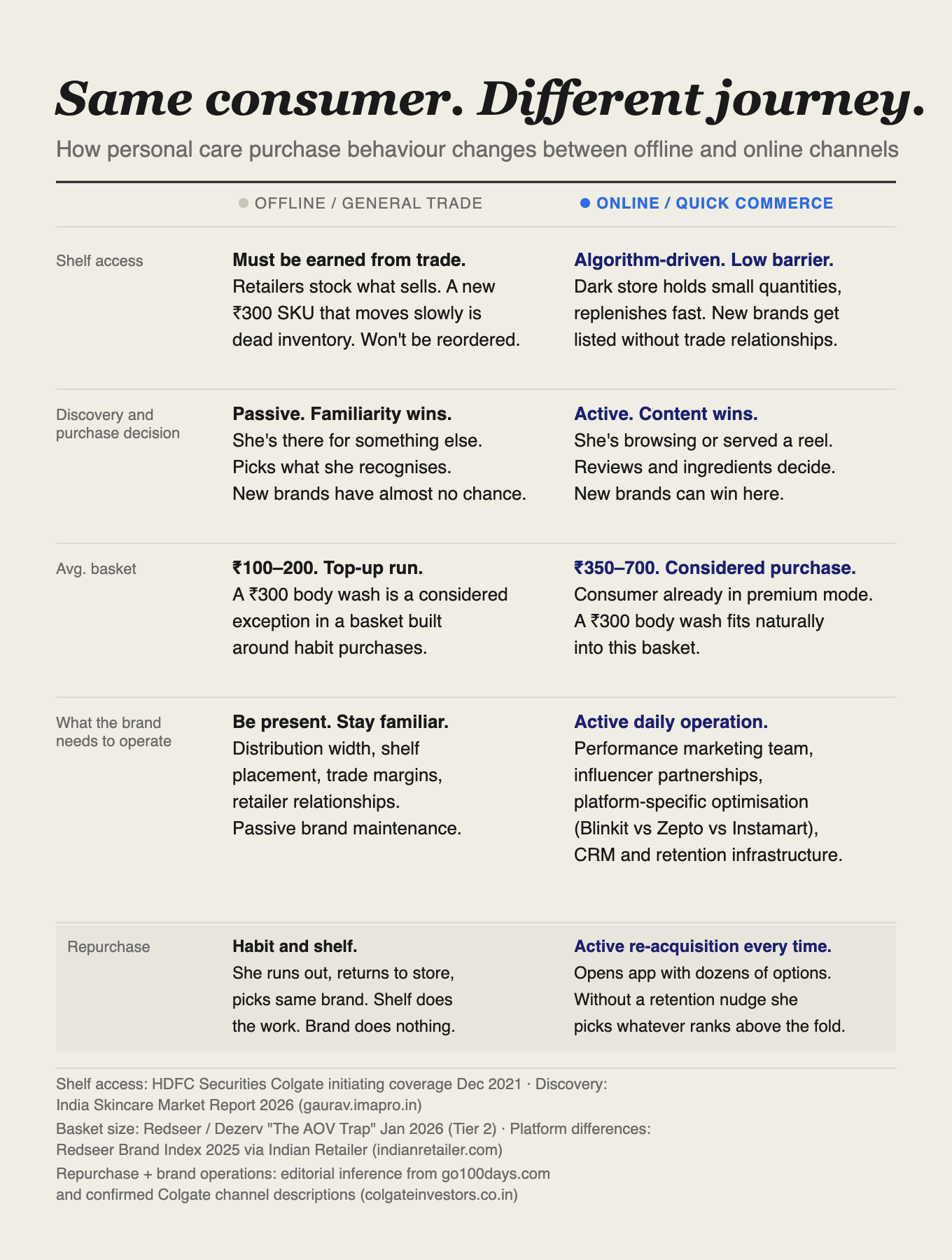
It’s on online channels.
Colgate tried to run that themselves.
But truth is you can’t convince a brand team to do digital marketing. it requires an entriely different skillset. This channel requires is an operator doing commerce — daily, on data, accountable to revenue not reach.
Bombay Shaving Company’s 100Days arm is built for exactly this.
It embeds inside a brand, owns the full digital commerce P&L, and runs every discipline the right column demands — performance marketing, influencer partnerships, platform-specific optimisation across Blinkit, Zepto and Instamart, CRM and retention infrastructure.
The best part?
Colgate APAC has held equity in BSC since 2018, and Narasimhan was explicit about what the partnership is for: Colgate is “looking to learn from Bombay Shaving Company.” Colgate is now explicitly trying to understand what selling online works. For context, BSC is being doing this for a while. Their FY26 operating revenue: ₹634.7 Cr, up 139% year on year, first positive adjusted EBITDA.
So, what’s the catch?
1. The commercial terms aren’t public.
Yes, BSC is handling end-to-end online marketing and sales for Palmolive. What Colgate pays for that: fee on revenue, shared P&L, fixed retainer has not been disclosed.
The structure determines who carries the risk if online Palmolive doesn't scale. It also determines whether BSC has any skin in the outcome. A partnership where the vendor is paid regardless of growth is a different bet from one where their economics are tied to Palmolive's. The arrangement is confirmed. The economics are not.
2. The D2C ceiling exists. But does it apply to Palmolive?
For Colgate, the ceiling may not be the point right now. But HUL’s own view, citing Bain, puts D2C brand saturation around ₹500 Cr.
For context, Minimalist crossed ₹690 Cr in FY26 under HUL. But the reason Minimalist broke that ceiling is HUL’s offline infrastructure. The brand is expanding from 3,000 to 40,000 stores on the back of HUL’s personal care distribution network. That path is not available to Colgate for Palmolive.
Colgate’s offline play in personal care is the milestones algorithm, a curated set of premium GT stores identified through toothbrush and toothpaste purchase patterns. That’s a real asset. It is not HUL’s personal care shelf.
So, the question for Colgate is more specific: can online consumer relationships with Palmolive build enough offline velocity in the stores the algorithm already identifies to justify expanding that network further? Colgate does this deliberately with its own premium oral care products — Max Fresh Sensorials launched online first, then travels to other channels as demand is proven. The Palmolive bet is the same sequencing applied to personal care. Online builds the habit. The habit earns the shelf.
3. Can BSC’s playbook actually travel?
Let’s be honest. BSC's proven category is men's grooming. Premium women's body wash, for a brand with 67% awareness and almost no purchase consideration, is a different brief. The machine can acquire a consumer. What it cannot do is manufacture brand pull that the brand hasn't earned through prior product experience.
What Colgate is doing is importing a capability it doesn’t have. Whether a 87-year-old oral care company can actually absorb a D2C operating model through a partner relationship has not been demonstrated anywhere at meaningful scale yet. Besides, can changing the model bump up Palmolive’s numbers. That’s a different question entirely.
Before you go.
Feel like everyone’s launching AI products while you’re still figuring out where to start? We’re launching a cohort where you go from idea to working prototype to real users in four days. No coding experience needed. Cohort begins 29th August.
Want to plug your brand into our newsletter?
Email us at collab@growthx.club