

Big sugar is eyeing a $3.6B opportunity
The real reason why sugar mills are moving to fuel ethanol.

Ethanol blending just hit 19.3%. The government called it a success. ₹1,44,087 crore cumulative forex savings. Import dependence cut.
But those producing the ethanol? They’re in greater debt than ever.
For perspective, India’s sugar mills, the factories that buy cane from farmers and turn it into ethanol, are sitting on ₹16,087 crore in unpaid farmer dues as of February 2026. A year ago, at the same point in the season, that number was closer to ₹478 crore. Why is that? How exactly did we get to here?

Feel like everyone’s launching AI products while you’re still figuring out where to start? We’re launching a cohort where you go from idea to working prototype to real users in four days. No coding experience needed. Cohort begins tomorrow.
Sugar mills were never meant to make ethanol.
Every sugar mill in India runs on a six-month clock. Cane arrives October through April. The mill crushes it, makes sugar, and then spends the next twelve months trying to sell what it made.
Demand is not the problem. After all, sugar consumption in India has grown steadily at roughly 3.7% annually for three decades. It’s the supply.
See, sugar supply is cyclical.
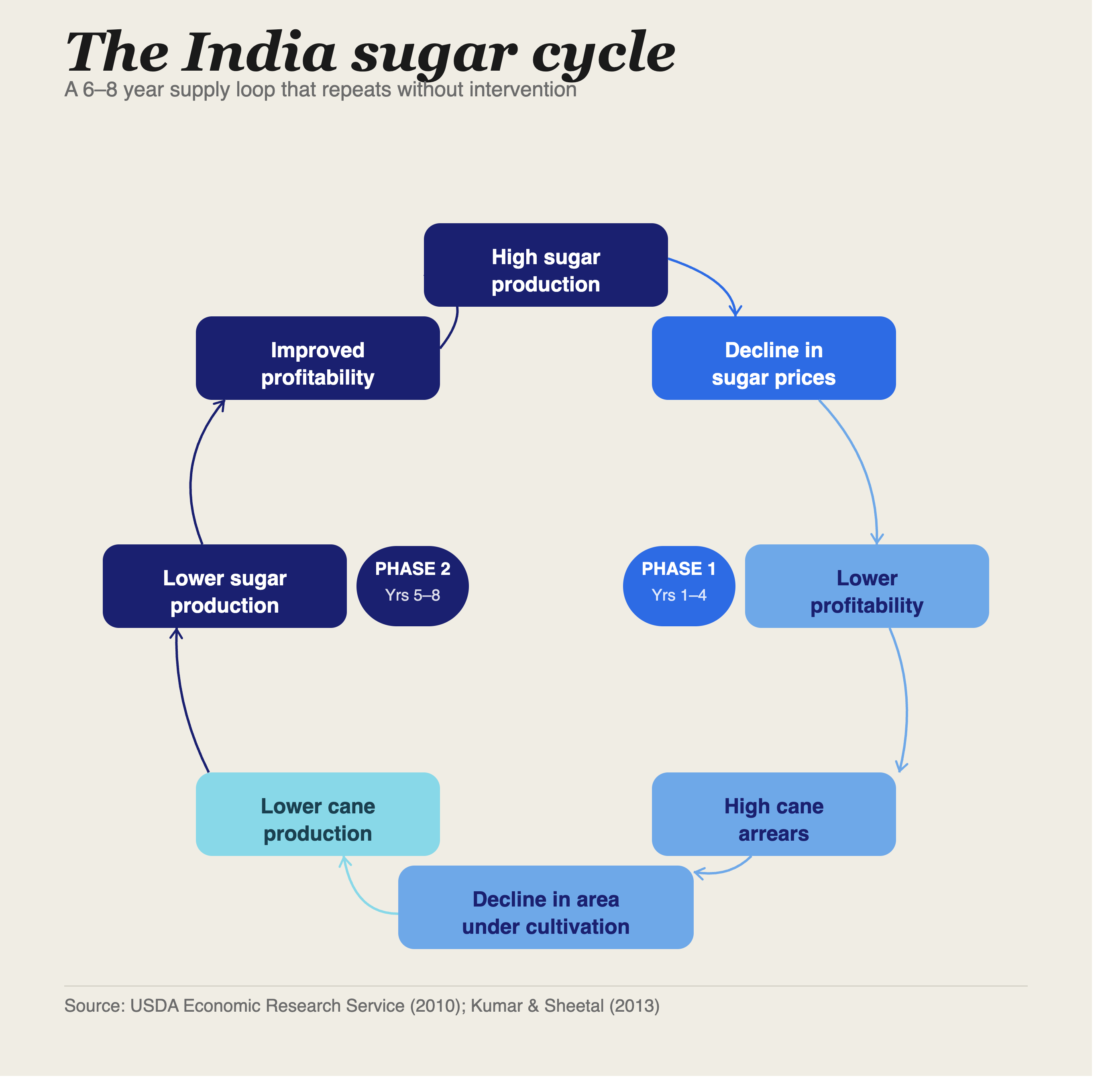
A good crop year produces surplus sugar. Prices fall. Mills, now earning less per kilogram than they paid per quintal of cane, start delaying payments to farmers. Arrears build. Farmers, unpaid and uncertain, start switching to other crops — wheat, paddy, anything with a faster, more reliable return.
Then less cane enters the system the following season. Sugar production falls. Prices recover. Farmers return to cane. The cycle starts again. It takes six to eight years to complete one full rotation.
This pattern isn’t unique to sugar.
Natural rubber runs on the same mechanism. In Malaysia and across Southeast Asia, feedback loops between global rubber prices and smallholder farmer income determine how much rubber gets produced — when prices fall, farmers reduce tapping or abandon their plots entirely, supply contracts, prices eventually recover.
Same goes for Indian dairy. In 2018, surplus skimmed milk powder pushed cooperative procurement prices down 20% — and industry bodies immediately warned that if not corrected, it would hit production the following season.
Both rubber and dairy recovered. Sugar didn’t.
The difference is that rubber farmers can exit. When rubber prices collapsed after 2011, millions of smallholders across Thailand, Indonesia, and Malaysia switched to oil palm.
Meanwhile, dairy found a structural solution: Amul made farmers the owners of the processor, so when the cycle turned down, the loss was absorbed by an entity the farmers themselves controlled rather than owed to them by someone else.
Sugar farmers in India cannot exit.
A mill is assigned a command area, typically 15 to 25 kilometres in radius. Every farmer within that area must sell to that mill. Why? Because transportation of the water-heavy sugarcane is easier for both the mill and the farmer.
Plus, the mill must buy everything they bring, at a price the government sets, regardless of what sugar is selling for. There is no equivalent arrangement in cotton, where the Cotton Corporation of India only intervenes when market prices fall below the support level, and when market prices are above it, no intervention happens at all. There is no equivalent in dairy, where the cooperative model redistributed ownership. In sugar, the lock runs both ways, and neither party can leave. Why is that?
Sugar is regulated by the government.
It must, because 5 Cr. farmers, a huge number, are engaged in sugarcane farming.
So, the government introduced FRP (Fair and Remunerative Price).
This is the minimum a mill must pay per quintal of cane, set annually by the central government. The price always goes up.
For instance, in 2025-26 it sits at ₹355 per quintal, up 29% from ₹275 in 2018-19. Mills cannot negotiate it down. Or refuse to accept it. In fact, several states even add a State Advised Price on top — in Uttar Pradesh, India’s largest sugar-producing state, mills pay ₹380 per quintal this season, not ₹355. Meaning protection extends to the farmer through FRP, not the mills.
Then came the MSP, or the Minimum Selling Price.
This is the floor below which mills cannot sell sugar. Set at ₹31 per kilogram in February 2019. Still ₹31 per kilogram today. The cost of producing a kilogram of sugar at current cane prices is ₹40.24, per ISMA’s own calculations. The mill is legally required to sell below its cost of production. But why?
Well, the MSP was originally introduced to ensure the mills had enough funds to pay the farmers for sugarcane, through a government-mandated price for the finished product. But as the cost of production grew, the MSP didn’t keep up.
Then there’s the MRM.
This is the Monthly Release Mechanism under which the government sets a monthly quota of how much sugar each mill is permitted to sell into the market. Why? So that supply gets spread evenly across twelve months, retail prices stay stable, and no mill dumps inventory at once to generate cash. Once again, the mill suffers.
Besides, the government handles cotton differently. The Cotton Corporation of India only enters the market when cotton prices fall below the support level. When prices are above it — as they were in 2016-17, 2021-22, and 2022-23 — no intervention happens at all. Cotton mills buy what they need at market prices. Cotton farmers sell to whoever offers the best rate. The government backstop exists but stays in the background. For the most part, everyone wins.
Why the difference in policy?
Three reasons:
1. Sugarcane must be crushed within 24 hours of harvest.
Beyond that, sucrose losses from moisture and inversion become significant. Meanwhile, cotton can be stored for months. So, a cotton farmer who dislikes today’s price can wait. Hence, the compulsory buying policy as well.
2. Sugarcane supports approximately 5 crore farmers.
And those are concentrated across roughly 60 Lok Sabha constituencies. Cotton involves around 60 lakh farming households spread across Gujarat, Maharashtra, and Telangana. When sugarcane arrears build, it is not a regional problem. It is an electoral emergency at national scale.
3. Finally, sugar sits in every Indian household’s ration card.
So, a spike in sugar prices hits the consumer price index directly and visibly — every kitchen in the country feels it within days. Meanwhile, cotton is an industrial input. Its price volatility diffuses through spinning mills, fabric manufacturers, and garment exporters before reaching the consumer, if it reaches them at all.
Simple.
But why diversify?
To be clear, mills did try other things first.
1. Branding.
The idea? You could command a premium for sugar that was sold as premium. Greater margins.
In fact, Triveni Engineering built a branded sugar business — ‘Shagun’, sold through organised retail, omnichannel, the works. The problem was the product itself. Sugar is chemically identical regardless of who makes it. Unlike branded flour or rice, it’s harder to justify a premium here.
2. Consolidation.
Whereby mills acquired other mills. That meant greater overall command area, more cane volume and marginally lower fixed costs per tonne. But it can’t change profitability when the government regulates demand and supply.
3. Policy lobbying.
In other words, convincing the government to implement policies that work in their favour. Once again, didn’t affect the industry much.
Diversification into by-products was way more convenient.
The cane was already in the mill. Bagasse was already being burned for captive power. Molasses was already accumulating as a processing residue. All they needed to produce ethanol from the same sugarcane they were mandated to buy was a distillery.
The government made that easy too. Guaranteed OMC offtake. Administered ethanol purchase price. Interest subvention on distillery loans. Sector-wide distillery investment crossed ₹40,000 crore. By ESY 2024-25, India had installed capacity to produce 1,900 crore litres of ethanol annually.
The OMCs contracted 1,048 crore litres that year. That’s less than 55% of installed capacity. ₹40,000 crore of investment running at barely half utilisation.
Behind India’s ethanol business.
Three public sector companies — Indian Oil Corporation, Bharat Petroleum, and Hindustan Petroleum — collectively purchase over 80% of all ethanol produced in India by volume.
They are the Oil Marketing Companies, the government-owned fuel retailers who blend ethanol into petrol and distribute the blended fuel through India’s roughly 90,000 petrol stations.
Here’s how that actually happens.
Each Ethanol Supply Year (November to October), the OMCs estimate their location-wise, depot-wise ethanol requirement and float a national tender. Distilleries bid. Contracts get signed.
The price? It’s set by the Cabinet Committee on Economic Affairs before the tender opens.
The mill supplies at that price for the entire supply year. No renegotiation. No market-linked adjustment.
For OMC’s, the benefit is straightforward.
India imports 88.5% of the crude it consumes.
Since ESY 2014-15, the blending programme has substituted over 310 lakh metric tonnes of crude oil and saved ₹1.90 lakh crore in foreign exchange, per the Ministry of Petroleum and Natural Gas. So, every litre of ethanol blended into petrol is a litre of imported crude oil they do not have to buy.
Sugar mills have a different reason to participate.
OMCs pay within three weeks of dispatch, compared to sugar that might only give returns after dispatch and sales. This is the reason ethanol improved working capital for mills during the boom years, even when the per-litre margins were not dramatically higher than sugar.
But with India already hitting 20% of blending capacity, further demand has reduced. The market absorbs roughly 1,000-1,200 crore litres per year but can produce ~2000 crore litres.
Have we maxed out on ethanol consumption?
At 20% mixing, it sure looks like it. Here are a few reasons why.
1. Electric vehicles (EVs).
Ethanol demand for fuel blends = Petrol consumption X Blend %
So, if people buy more EVs and petrol consumption drops, ethanol demand would drop too. That said, EV penetration is slowly increasing, so it’s highly unlikely that sugar mills face a direct threat from them currently.
2. Compliant vehicles.
India mandated E20-material-compliant vehicles from April 2023 and E20 engine-tuned vehicles from April 2025. Every vehicle manufactured before April 2023 was designed for E10 or lower blends. The verdict is still out on whether higher ethanol-blended fuels impact vehicles older than 3 years. But if they do, the demand for blended fuel will go down as well, meaning the sugar mills will lose money.
3. Regulatory compliance.
For instance, when domestic sugar stocks tightened ahead of the 2024 general election, the government banned sugarcane juice and B-heavy molasses from ethanol production mid-season — the two highest-value feedstock routes — trapping mills in low-value C-heavy production and disrupting contracted OMC supply.
Reasons aside, it could happen again, this time impacting ethanol production itself.
So, what do we do?
1. Launch flex fuel vehicles.
India launched its first commercial flex-fuel two-wheelers in June 2026. Hero MotoCorp’s Splendor+ and HF Deluxe, both E20-compliant, are rolling off the line and into a market the government has been priming for a decade. NO one is sure of what will happen next.
Brazil is the only country that has actually solved this. It spent 28 years building distilleries and pump infrastructure before it put flex-fuel vehicles on the road in 2003. By the time the first car rolled out, ethanol was at every station. Within three years of launch, flex-fuel vehicles accounted for 77% of new car sales.
Compare that with India, for a moment. Even after the launch of flex-fuel vehicles, we have only 48 E85 outlets compared to over 1,00,000 fuel stations.
Besides, we have a much bigger uphill battle.
CEEW’s total cost of ownership modelling for 2028 found petrol is still 2-14% cheaper than E100 across six states at current retail prices. For ethanol to reach cost parity at the pump, it would need to retail at ₹52-73 per litre. That’s much below the production cost of any commercially viable feedstock today.
2. Get into aviation fuel.
On April 17 2026, the Ministry of Petroleum and Natural Gas amended its Aviation Turbine Fuel marketing rules to formally permit SAF blending through the alcohol-to-jet pathway. India’s mandate: 1% SAF on international flights by 2027, scaling to 5% by 2030. Indian Oil Corporation’s Panipat refinery became India’s first certified SAF producer in August 2025, with an annual capacity of 3 crore litres.
Crucially, this is the first time in the ethanol space where the government isn’t the price setter. Only the market-linked rate exists. The catch? Distillaries will still have excess capacity waiting to get used.
3. Exports.
First-generation ethanol from sugarcane, maize, or grain remains prohibited for export as of July 2026. Minister Gadkari called for exports publicly in September 2025. ISMA has petitioned formally.
The permission has not come — for the same reason the MSP was frozen in 2019, and the December 2023 feedstock ban lasted eight months. Allowing sugarcane ethanol to leave reduces domestic supply, which pushes sugar prices up, which the government will not permit. The political logic has not changed. The surplus has only grown.
Will we be able to change policies to manage the surplus better? Only time will tell. Until then, we’ll keep watching.
Also, we have a new business breakdown on YouTube.
Want to plug your brand into our newsletter?
Email us at collab@growthx.club
Interesting read!
Just one correction - the MSP for mills is actually the floor price/support price to help them earn at least that much per kg sold, not the ceiling. The article says they are legally required to sell below the production price, which is not true.