

Behind Reliance's ₹10.58 lakh Cr. AI bet.
Which parts of the AI goldrush is the conglomerate actually built to win?

Before we begin.
200 builders. 8 hours. ₹10L prize pool. Only one rule.
Build a production-grade tool in voice agents, document intelligence, and multilingual AI products on the Sarvam stack. Tickets for the Sarva Epoch Buildathon are now live.
Today’s edition.
Reliance has spent sixty years in practically every non-AI business that exists. First, oil and petrochemicals, then retail, telecom and financial services.
Now, in February 2026, at the AI Impact Summit, Mukesh Ambani added a fifth: ₹ 10.58 lakh Cr. (~$109.8 billion, at ₹96.4/$1, July 21, 2026) for AI over the next seven years. For reference, Reliance’s entire market cap sits at around ₹17.9 lakh Cr. That’s nearly 60% dedicated to AI.
The question isn’t whether Reliance can afford this. But it’s why take such a big bet at all? And more importantly, can they really win?
1 month of Granola free. Start today.
We’ve tried several AI note-takers at GrowthX, and Granola has been our go-to for the past year. It gives us comprehensive prep notes before every meeting, near-accurate transcripts, and even makes follow-up tasks like emails and planning easy. Try Granola Pro free for 1 month by signing up using the link below.
The AI land grab in 2026.
AI companies are being built in four places.
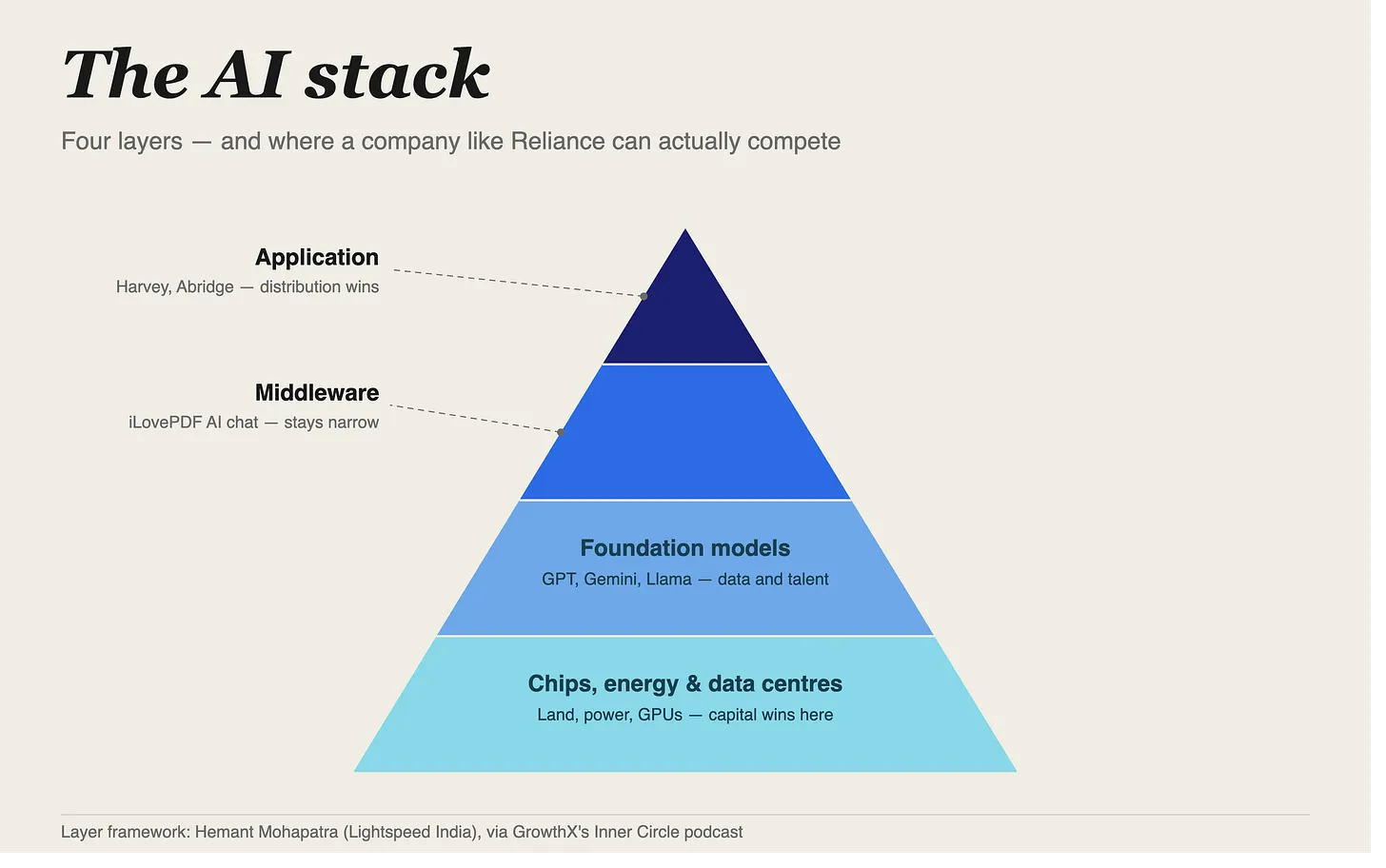
i. Applications
These are tools that solve individual problems like finding doctors or helping farmers sow better. Distribution decides which company will win.
More users = more revenue. Simple.
No one can touch Reliance here.
524 million subscribers. 268 million already on 5G. Four AI apps launched at its June AGM: JioBharatIQ, JioHealthIQ, JioLearnIQ, JioKrishiIQ, all pitched as AI for the next billion users, all ride straight into that network. Plus, most of these apps are rebranded from earlier. Meaning they benefit from borrowed familiarity as well.
They’re also launching into occupied ground. Take Practo, for instance.
They’ve spent eighteen years building a doctor network five lakh strong, pulling ten million monthly visits from people who already trust it with their bookings. DeHaat reaches 1.4 million farmers through physical centres every few kilometres, not just an app icon. A government farming app has run advisories in five languages since 2016.
Reliance’s reach is bigger. But can it transfer its competitor’s decades of trust by tapping into a larger user base faster than word of mouth?
ii. Middleware
Middleware sits between the model and whatever gets built on top of it. The problem? Its function could be gone by the next model update.
JioBrain falls in this category. Launched in August 2024, built exactly that way: call analysis, fraud detection, customer experience insights, drawn from data flowing through Jio’s own network.
The pitch was always to sell this to other telecom operators. But why would a rival telco have much reason to buy AI tooling from the company it competes with for the same subscribers every day?
iii. Foundation model layer
A foundation model needs two things a balance sheet can’t buy quickly: enormous proprietary data, and years of research talent that isn’t for sale on short notice.
Google and Meta had both long before AI became the story worth telling. OpenAI had neither, and won anyway, on research depth plus a compute partner patient enough to fund the wait.
Reliance has hired for this.
Gaurav Aggarwal, ex-Google DeepMind, now runs research at Reliance Intelligence. But take a look at what’s shipped once.
Reliance’s enterprise AI venture, a joint venture with Meta worth ₹855 crore, runs on Meta’s Llama, not anything trained in-house. No source names what model sits underneath JioBharatIQ. And the Gemini partnership, bundling Google’s model free to Jio subscribers since August 2025, is still running today, ten months after JioBharatIQ shipped.
iv. Infrastructure
Building AI infrastructure means assembling four things at once: land large enough for a gigawatt-scale campus, a steady water supply for cooling, a power connection big enough to run it, and the GPUs that actually do the computing.
Space is real, but solvable with money. A gigawatt-scale campus needs hundreds of acres, and land at that scale gets expensive fast in the wrong city. Water is a harder constraint in dry states, forcing costlier cooling systems when it isn’t there. Energy is the real chokepoint. Getting a new high-capacity grid connection approved can take years, longer than most of the infrastructure it’s meant to power. GPUs sit on top of all of it, gated by a global supply chain nobody, not even a company this size, controls outright.
Reliance is playing at this layer specifically. But why?
Behind Reliance’s big AI infrastructure bet.
There are three ways to get infra in AI.
a. Build it out yourself.
Google, Microsoft, Amazon, and Meta each fund this from their own balance sheets, buying land, negotiating grid power from zero, building the whole facility. Slowest of the four paths, because everyone joins the same power-connection queue, but the only path that needs no outside capital and no landlord’s cooperation.
b. Chase power wherever someone already has it
CoreWeave’s $8.6 billion deal retrofitting Core Scientific’s old crypto-mining sites is the clean example: those sites already carried the heavy-duty electrical connections AI compute needs, built for an entirely different purpose. It’s the fastest path to live capacity, at the cost of depending on someone else’s site and someone else’s terms.
c. Repurpose land and power from an entirely different business.
Here’s the thing. An oil refinery is already one of the most power-hungry things you can build.
Jamnagar, Reliance’s own site, doesn’t just sit on land, it sits on land that already has industrial-scale power lines running to it, because refining crude oil at that volume needs enormous, constant electricity just to operate. The substations, the grid connections, the transmission infrastructure a new AI campus normally has to negotiate for from zero, over years, already exist there, built decades ago for a completely different reason.
Now, two more pieces that happen to already be in place. Kutch, where Reliance built renewable power capacity for its energy business, sits close enough to feed the same site. And Jamnagar’s coastal location means cooling can run on desalinated seawater instead of competing with a dry region’s drinking water supply, the exact water-stress problem slowing other Indian projects down.
Adani runs its data centre with identical logic, using its power generation company to supply energy.
But these methods solve one problem: power. What about the GPUs?
The Achilles heel of the AI race.
It’s compute. But what is it?
Compute means GPUs, the specialised chips that actually run AI. One company, Nvidia, makes almost all of them. Therein lies the problem.
It’s not Nvidia. It’s that a component inside every GPU called high-bandwidth memory, made by only three suppliers worldwide. Lead times on these chips now run 36 to 52 weeks. In fact, some orders placed today don’t arrive until 2027.
On top of this, Microsoft, Google, Amazon and Meta have already placed their orders throughout 2025. Meaning Nvidia is swamped with fulfilling those orders till God knows when.
Will Reliance’s AI bet pay off?
A few things are in favour of Reliance right now.
REIL, the joint venture with Meta, is a signed 70/30 deal worth ₹855 crore, incorporated in October 2025. It’s operating today, selling enterprise AI tools built on Meta’s Llama models to businesses.
That aside, Meta separately leased 168MW of Jamnagar capacity in June 2026. Its construction is underway, and it is running toward Meta’s own workloads once complete. Plus, Google committed to a dedicated Jamnagar Cloud region the same month.
And yet, no layer, infrastructure, compute, model, or application has produced a disclosed rupee of revenue for Reliance. Adani is running the same play at comparable scale and has 2 gigawatts built and generating something today.
Reliance picked the layer where its assets happen to fit. Whether that turns into revenue is still an open question.
Want to plug your brand into our newsletter?
Email us at collab@growthx.club