

Behind Milky Mist's ₹3,145 Cr. business
Why India's most promising dairy business doesn't sell fresh milk.

Milky Mist just opened what may be India’s biggest dairy IPO, raising ₹1,553 Cr on a business model no other dairy company uses.
Every dairy company in India sells milk. Amul’s milk business is 96% of its revenue. Hatsun’s is 70%. Milk is a daily visit. It’s the reason the consumer opens the fridge. Paneer, cheese, and curd all ride that visit.
Milky Mist sells no fresh milk and has built a ₹3,145 Cr. business out of it. But can the very model that got them here take them further?

Feel like everyone’s launching AI products while you’re still figuring out where to start? We’re launching a cohort where you go from idea to working prototype to real users in four days. No coding experience needed. Cohort begins 29th August.
Why did Milky Mist take the VAP route?
Liquid milk is an 8–9% EBITDA business. Paneer and cheese can reach 30–50%. Every litre of milk that goes into a pouch earns a fraction of what it earns as paneer. The industry has known this for decades.
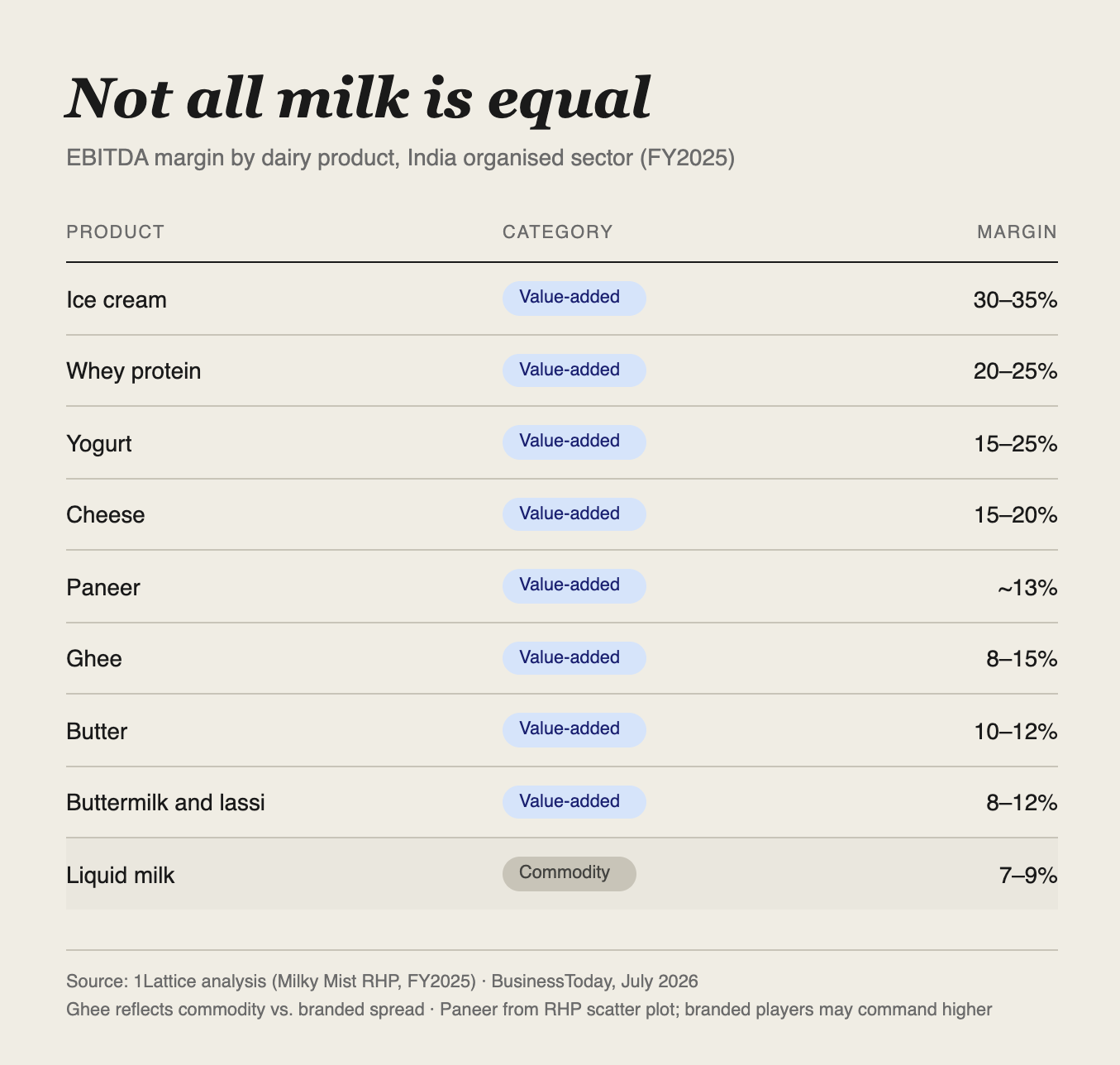
Yet Amul still gets 96% of its revenue through milk. Hatsun runs 70%.
See, co-operatives like Amul exist to solve farmers' problems. They were built to absorb every litre a farmer produces and return 85 paise of every rupee earned back to those farmers. Exiting milk isn’t an option here.
Private players like Hatsun carry milk for a different reason: frequency. Milk earns the daily fridge visit. Value-added products (VAP) ride it.
When Milky Mist entered the market in the 1990s, paneer was a wedge.
For context, 90% of paneer in India was still unorganised. It was made in small batches, with no cold chain and no brand. South India barely consumed it. Milky Mist’s own CEO, K. Rathnam, described the logic plainly: the south was vegetarian-heavy, non-vegetarian consumption wasn’t daily, and paneer was virtually absent. It was a category with real demand and almost no organised supply.
The real problem with VAPs.
Let’s take a look at Milky Mist’s product catalogue for a second.
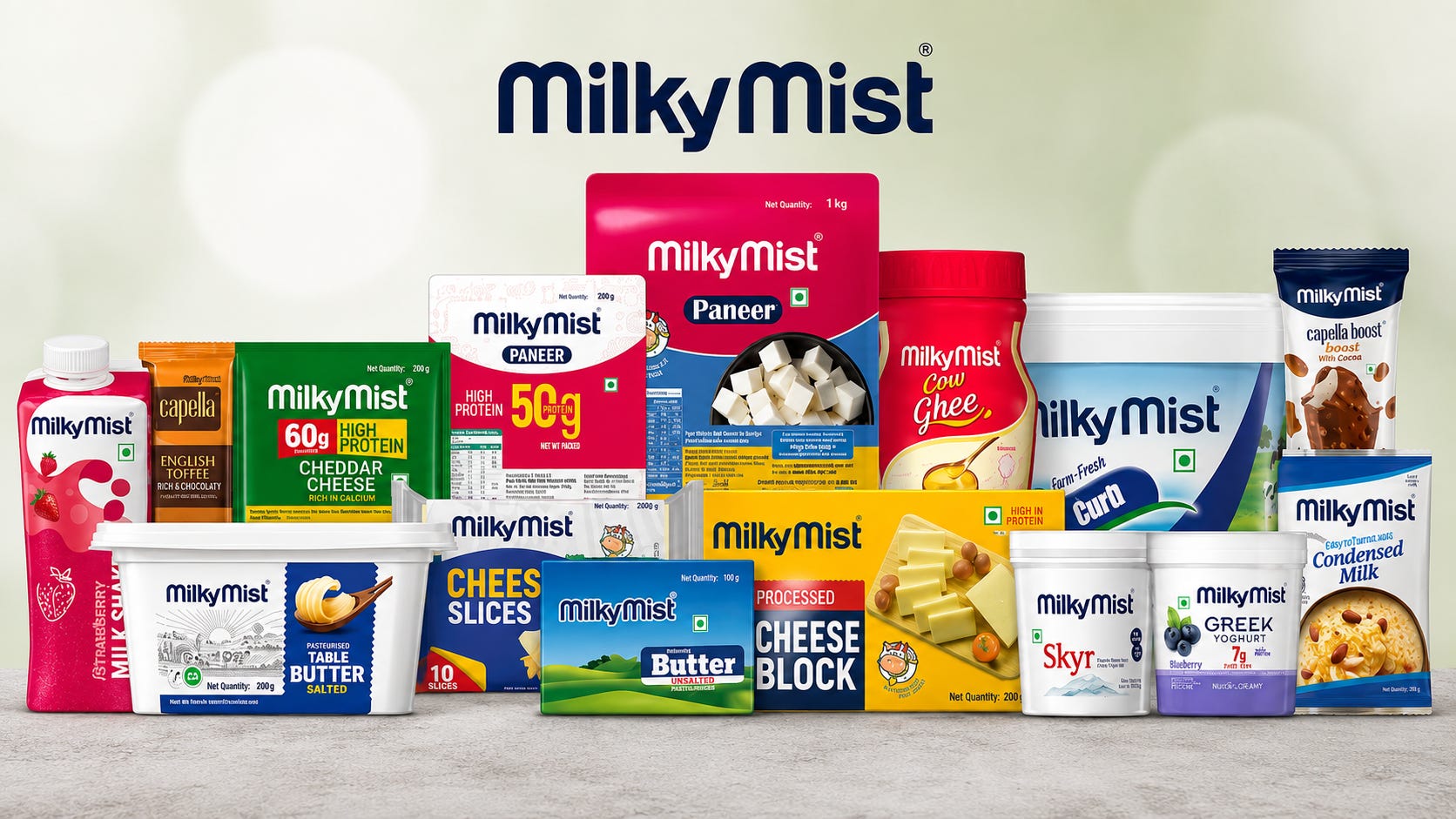
Every product in Milky Mist’s catalogue is a low-frequency buy. Paneer is weekly at best. Even cheese is occasional. That means fewer brand touchpoints per consumer per month, and a harder path to cross-selling anything else.
Milky Mist has two answers to that.
1. Infrastructure
When retailers wouldn’t give Milky Mist shelf space in their existing chillers (most shops at the time carried only Pepsi or Coke), Sathish Kumar supplied his own, free of charge.
The cooler in-store became the brand touchpoint milk would have been. There are 14,000 Milky Mist chillers across South India today.
2. Digital reach
At 13.70% of FY26 revenue and growing, quick commerce puts Milky Mist in front of a consumer the moment they search. This is buying the occasion without earning the habit.
The Asal and Briyas acquisitions, chapati and dosa batter, and tofu are used daily. Together, they contributed 2.7% of FY26 revenue.
The case for VAPs.
See, the further a product travels, the higher the delivery charges.
That relationship has two layers for dairy.
1. Cold chain costs compound with distance: reefer transport in India runs ₹50–72 per km for chilled cargo, roughly 50–70% more than dry freight at the same distance.
2. And the product must arrive before it spoils.
Besides, there’s another problem.
There’s always a locally made alternative, produced three kilometres from the retailer, that arrives fresher and cheaper.
At some distance from the plant, the compounding cost of transit, plus the shrinking shelf life, together make the distant product uncompetitive against the local alternative. That threshold is the competitive radius — the geography within which a product can be sold profitably against a local producer. That radius shifts directly with shelf life.
Fresh pouch milk has the tightest radius of any dairy product. Two to three days, mandatory cold chain, hyper-local by physics. Curd runs seven to ten days. You get the drift.
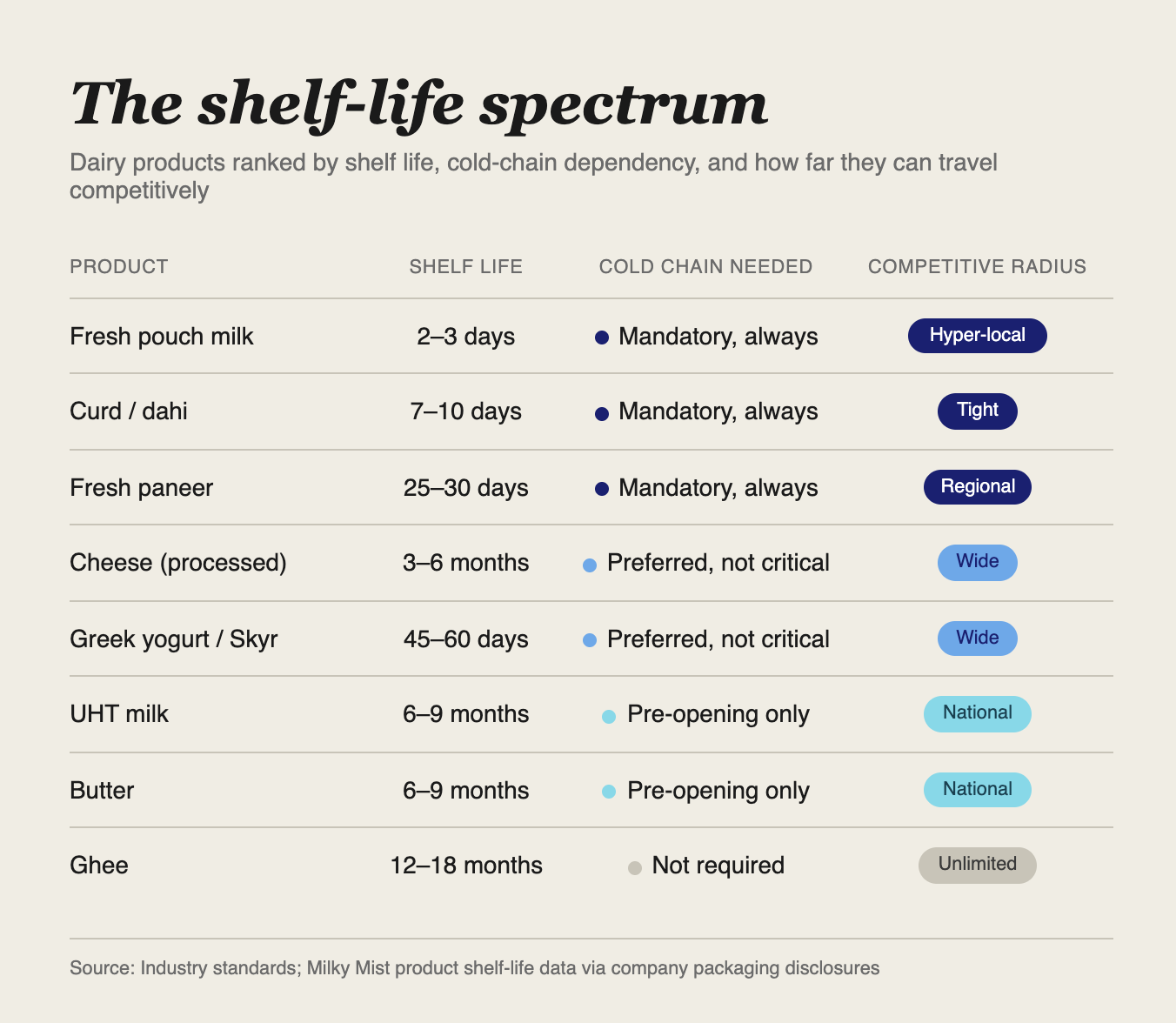
The all-VAP model carries a structural advantage.
These products travel farther, at lower cost per unit, while staying competitive on freshness. Higher margin per litre, wider radius from the same plant.
Milky Mist's portfolio spans the full spectrum.
1. Paneer and curd at the tight end: regional radius, mandatory cold chain, high infrastructure cost per kilometre.
2. Greek yoghurt and cheese in the middle: wide radius, preferred but not critical cold chain.
3. UHT, butter, and ghee at the far end: national or unlimited radius, ambient distribution.
The fastest-growing products (Greek yoghurt reached 35 to 40% of India's organised Greek yoghurt market from the Erode plant alone) sit at the wider end of the spectrum. The products that built the business sit at the tight end.
The milk inside the moat.
Milky Mist’s Perundurai plant can process 25 lakh litres of milk a day. Currently, it processes 14.
That’s a procurement problem.
See, producing one kilogram of any value-added product takes five to seven litres of raw milk, and securing enough of it is what constrains how fast the portfolio can grow.
The company launched a contract farming program: 500 farms in 18 months, cattle financing, green fodder support, not to sell more paneer, but to get more milk. The RHP flags raw milk procurement as the primary operational risk, ahead of competition, distribution, and anything else.
Currently, the bulk of that milk is collected through one of 3,907 automated milk collection units, chilled at one of 29 chilling centres, and trucked to Erode. 94.51% of that milk is from Tamil Nadu, sourced without formal contracts from 74.34% of the farmers. Meaning three-quarters of the raw material could walk to a competitor tomorrow.
Hatsun understood this back in 1970.
It built its national scale by going the other direction: liquid milk first, at volume, across multiple states, through 13,100 Hatsun Milk Banks that aggregate raw milk directly from farmers. That milk collection network is what made Hatsun a national company.
The VAPs, ice cream, and curd, now roughly 45% of its product mix, came later, riding on a procurement infrastructure that already covered the country. At ₹9,972 Cr in FY26 revenue, Hatsun still accounts for over 50% of revenue in Tamil Nadu. It took five decades and sequential plant builds across Maharashtra, Andhra Pradesh, Telangana, and Odisha to get even that far. The milk came first. The geography followed the milk.
Milky Mist built the moat by refusing milk. Now, it needs the same milk to scale. This is why Milky Mist is investing in a contract farming program, the Maharashtra plant, and the 3,907 collection units.
With the IPO, Milky Mist is valued at 85X its earnings.
Higher than every other daily company in India.
One reason why. It’s considered FMCG.
Milky Mist runs no low-margin liquid milk, so its 13.87% EBITDA margin looks less like a dairy processor and more like a packaged-foods company. Brokers say the premium is justified by “FMCG-like margins and a pure-play value-added dairy business.”
Whether that assumption holds is still an open question.
Before you go.
Getting good at AI isn't a solo sport.
Anyone can build in isolation. But the people who move fast do it inside a community with live feedback from people who've already solved the problem you're stuck on. GrowthX gives you that, plus AI credits from top companies and weekly AI sessions.
Want to plug your brand into our newsletter?
Email us at collab@growthx.club
Placing chillers for brand recall is good step but don't you think this is a costly capex game to play Also, I am sure Milky Mist at some point of time would want to charge for placing chillers [which would again be tough exercise and going against the tide]; but ain't this 'too much if's' game at present moment where you are asking 85x?