

AI's coming for serials. Will you watch?
Kuku TV is betting ~₹3500 Cr. on it.


Pretend you’re building a media platform from scratch. You’ve got no audience and no money to host content. Plus, you’re butting heads with the likes of JioHotstar, Prime, and Zee5.
Winning? Forget about it. The question is: can you exist for long enough?
Kuku TV launched in 2024 without an audience or a content library. As of 2026, they’re doing ~₹1400+ Cr. in revenue. It’s supposed to be impossible by every metric. So, how are they doing it?
Today’s edition is brought to you by Wispr Flow.
Wispr Flow makes writing quick and clear with seamless voice dictation. It is the fastest, smartest way to type with your voice. Our entire team has been obsessed with it since it launched. Try Wisprflow Pro for 3 months absolutely free by signing up using the link below.
The ‘right moment’ problem.
Every moment of content consumption is already contested.
Think about it.
Major platforms have called for dibs on the large moments. Netflix and Prime hold the everyday show-and-movie time slot. JioHotstar has captured the IPL season unilaterally. Zee5, SonyLiv and others have captured the daily soap watchers and the vernacular content gap. All your content consumption time slots are nearly gone.
One time slot is still up for grabs, though.
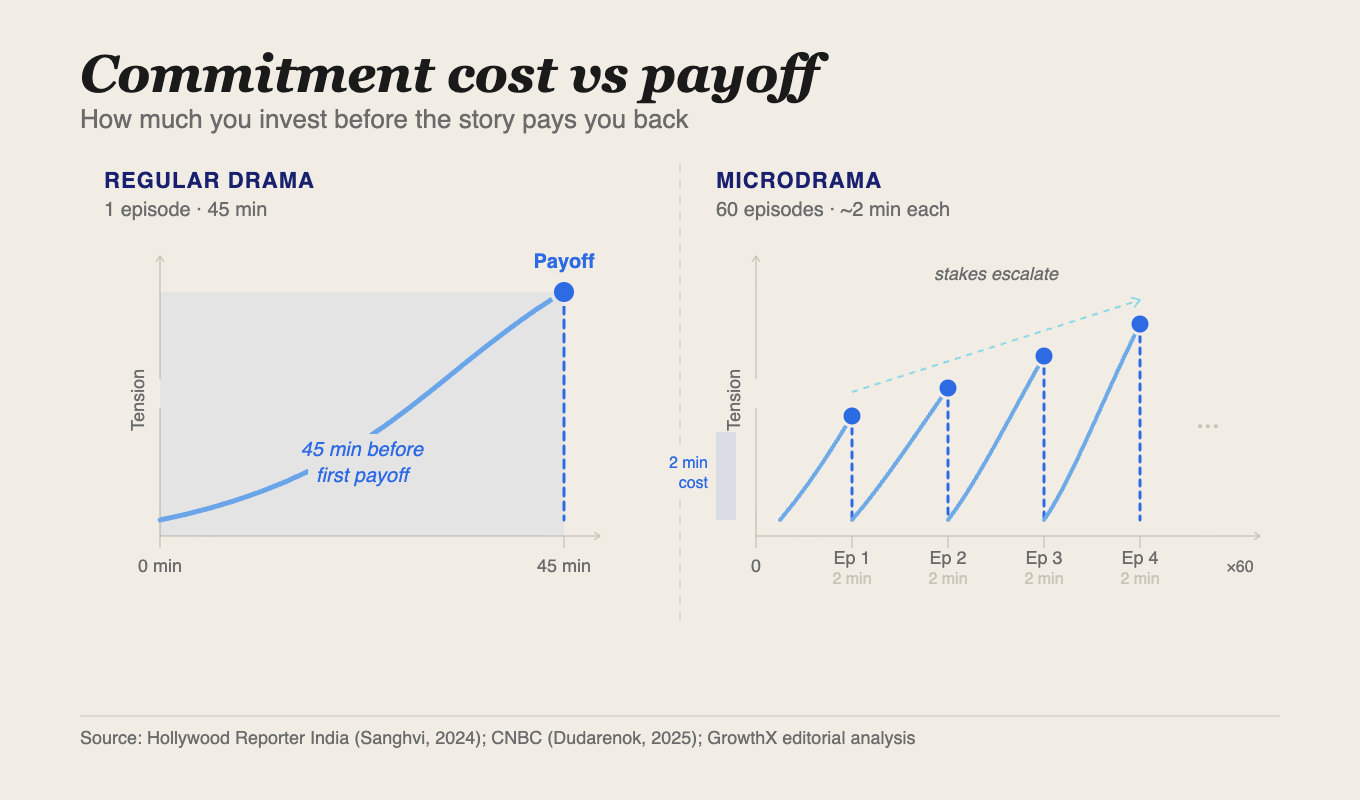
The stolen moment — in a commute, a lunch break, even the washroom break. People are using their phones for most of the time anyway. Only they’re most likely watching reels or shorts.
Kuku’s insight? Capture this market by building a premium OTT platform tailored to vertical micro-dramas.
China validates this hypothesis.
By June 2024, 576 million Chinese internet users (52% of the country’s online population) were watching microdramas. Reports suggest in 2024, revenue from microdramas crossed those from the box office too!
Getting over the cold start.
Every platform that survived India’s streaming wars had a non-content wedge that brought in the first audience. Hotstar had cricket rights. ZEE5 had three decades of television that people had already watched. Amazon attached video to a shopping subscription. MX Player had 175 million utility app users before it showed a single frame of original content.
Kuku TV launched in February 2025 with none of those. But they had a strong base of vernacular subscribers who had been paying for their audio content for years. All they had to do was show them the video content.
Enter cross-promotion.
When the video app launched in February 2025, cross-promotions within Kuku FM gave it an immediate seed audience that’s vernacular, cliffhanger-conditioned, with payment methods already on file.
It worked. By September, 2025, Kuku TV alone had ~88 Mn downloads.
Monetising a stingy customer.
Netflix charges ₹649 a month. And people pay that for a reason.
The user makes one forward-looking decision: is this library worth ₹649 over the next 30 days? And the platform’s job is to make that decision land in its favour every month, forever.
Justifying that price requires prestige content. Blockbusters. Global IP that costs more to produce than most Indian platforms earn in a year.
Amazon subsidises the same problem differently.
Prime Video’s content spend is justified by e-commerce retention, not video revenue alone. Both models require either a massive content investment or a parent business to fund it.
Kuku charges ₹199 per month for most of its shows.
At that price point, traditional production economics collapse. A single episode of a Netflix original costs more than Kuku’s annual subscription revenue from one user. The only way the math survives is if the production cost per episode is so small that volume content creation is possible.
So, that’s why the push for AI-assisted content.
The VIP content is unlocked only with special coins.
Here, users purchase in-app currency to unlock VIP episodes, regardless of whether they already have an active plan. Coins unlock only VIP-designated shows, and once purchased, never expire. But why?
The coins model does three things a flat subscription can’t.
1. It removes the trust barrier.
₹10 is the smallest possible commitment for a first-time digital spender, low enough to cross without deliberation, and crossing it once makes every subsequent payment easier.
2. It captures two user types simultaneously.
The impulsive unlocker who never commits to a subscription and the recurring subscriber who does, both generating revenue from the same content.
3. It creates a dormant state that pure subscription can’t.
A subscriber either pays or churns. A coins user can go quiet between series without a cancellation decision, then reactivate the moment the next compelling series drops.
Does Kuku have a defensible moat?
Nope, every major media platform now offers a microdrama.
When JioHotstar launched Tadka in April 2026, it put microdramas in front of its customer base for free, running on top of IPL traffic. Amazon launched Fatafat inside MX Player’s ad-supported free tier in March 2026. ZEE5 launched Bullet. Balaji launched Kutting.
Kuku cannot compete with platform envelopment.
After all, JioHotstar does not need Tadka to be profitable. Tadka failing quietly would cost JioHotstar nothing; the 280 million subscribers wouldn’t notice. Kuku needs microdramas to win. There is no other product. For now, Kuku TV has the better microdrama collection and habit, so the customers won’t switch.
This is the distribution end of the squeeze.
Tadka doesn’t need to be better than Kuku. It needs to be free and present. JioHotstar has 280 million subscribers. Kuku has to be worth a separate download and a separate subscription to a user who already pays for cricket. That is a high bar when the incumbent is offering the same format at zero additional cost.
The production end of the squeeze is Dashverse.
Frameo, its generative video studio, is being opened to creators. It has a revenue-share model targeting 500 shows a month by late 2026, with AI-generated completion rates already above 80%. Kuku’s AI stack is proprietary. Dashverse is a platform anyone can build on. If Frameo becomes the infrastructure layer for Indian microdrama production, the cost moat Kuku spent two years building becomes available to every platform, including the incumbents.
That’s two threats at opposite ends commoditising Kuku’s advantages: vernacular depth, AI production economics, and the stolen-moment habit from both sides simultaneously.
What survives the squeeze is the one thing neither competitor has built — a habit. Over 90% of Kuku’s subscribers remain active month over month. Users already mid-series, already inside the cliffhanger loop, already paying, are not easily displaced by a free alternative they haven’t started yet.
What’s next for Kuku?
In FY25, Kuku spent ₹1.70 to earn every rupee of revenue. Advertising alone accounted for ₹285 crore, exceeding the total operating revenue of ₹242 crore. The sourced FY26 figure is ₹1,400 crore.
Either the economics inverted completely in twelve months, or the number is carrying assumptions that the DRHP will eventually have to defend.
Kuku built something real. The format works. The habit is genuine. Thirty-seven million people opened the app last month. The question the IPO is asking is not whether any of that is true. It is whether it is worth ₹15,000 crore at a cost structure nobody outside SEBI has seen, in a category where Tadka just hit 100 million users for free, with an AI production moat that a competitor is turning into open infrastructure.
The DRHP will answer some of this. The market will answer the rest. And we’ll keep watching.
Basic Plan (₹199/month): Watch on 1 supported device at a time (phones, tablets, computers, or smart TVs) in High Definition (HD/720p).